
Ch.4 - Reactions in Aqueous Solution
Brown - Chemistry: The Central Science 14th Edition
Brown14th EditionChemistry: The Central ScienceISBN: 9780134414232당신이 사용하는 게 아니라요?교과서 변경
4장, 문제 51b

Which element is oxidized, and which is reduced in the following reactions? (b) 3 Fe(NO3)2(aq) + 2 Al(s) → 3 Fe(s) + 2 Al(NO3)3(aq)

검증된 단계별 안내
1
Identify the oxidation states of each element in the reactants and products. For the reactants: In Fe(NO3)2, iron (Fe) typically has an oxidation state of +2 and each nitrate (NO3) group has an oxidation state of -1. Aluminum (Al) is in its elemental form, so its oxidation state is 0. For the products: In Fe, iron is in its elemental form, so its oxidation state is 0. In Al(NO3)3, aluminum has an oxidation state of +3 and each nitrate group still has an oxidation state of -1.
Compare the oxidation states of each element in the reactants and products to determine the changes. Iron (Fe) changes from +2 in Fe(NO3)2 to 0 in Fe, indicating a decrease in oxidation state, which is a gain of electrons (reduction). Aluminum (Al) changes from 0 in its elemental form to +3 in Al(NO3)3, indicating an increase in oxidation state, which is a loss of electrons (oxidation).
Conclude which element is oxidized and which is reduced based on the changes in oxidation states. Aluminum (Al) is oxidized as it loses electrons (increase in oxidation state from 0 to +3). Iron (Fe) is reduced as it gains electrons (decrease in oxidation state from +2 to 0).
Write the half-reactions for each process to further illustrate the changes. Oxidation half-reaction: Al(s) → Al^3+(aq) + 3e^-. Reduction half-reaction: Fe^2+(aq) + 2e^- → Fe(s).
Combine the half-reactions to check if the overall electron transfer is balanced, ensuring the number of electrons lost in oxidation equals the number of electrons gained in reduction.

비슷한 문제에 대한 검증된 영상 답변:

이 영상 해법은 위 문제에 도움이 된다고 튜터들이 추천한 것입니다.
영상 길이:
1m
도움이 되었나요?

주요 개념

질문에 올바르게 답하기 위해 반드시 이해해야 하는 핵심 개념들은 다음과 같습니다.

Oxidation and Reduction

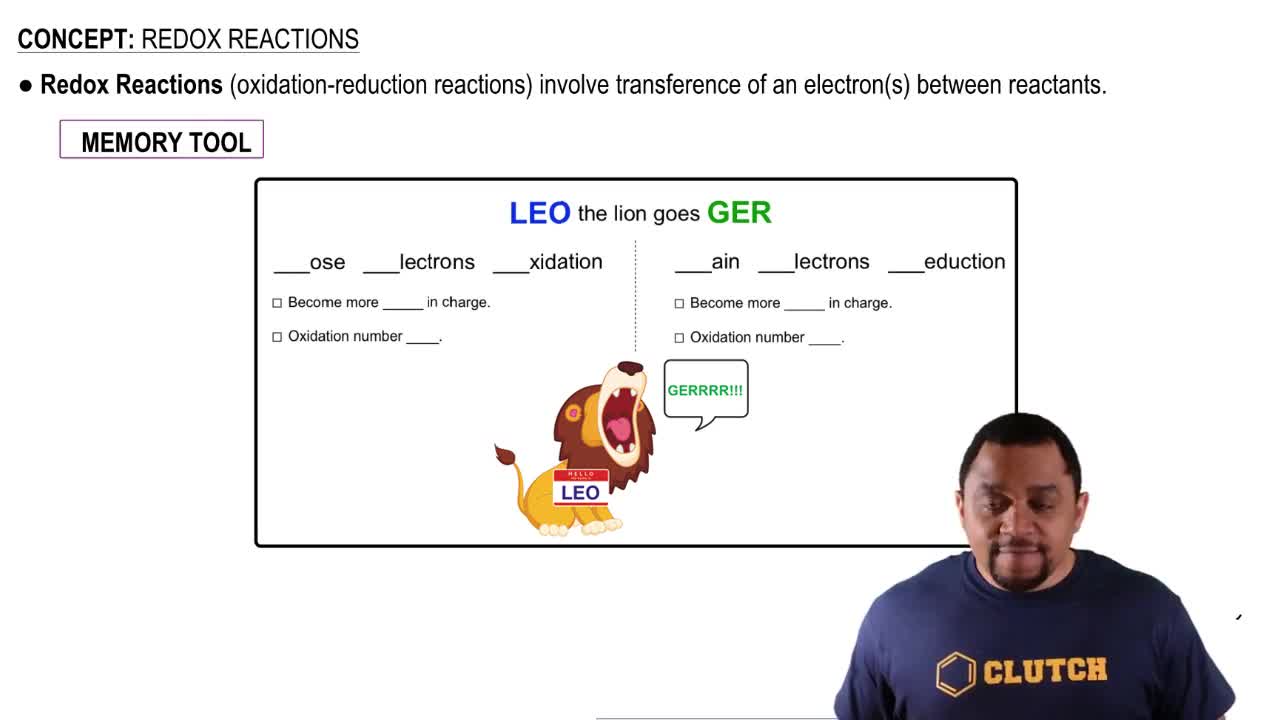
Oxidation and reduction are chemical processes that involve the transfer of electrons between substances. Oxidation refers to the loss of electrons, resulting in an increase in oxidation state, while reduction involves the gain of electrons, leading to a decrease in oxidation state. These processes always occur simultaneously in a redox reaction.
추천 영상:
가이드 코스
01:53
Oxidation and Reduction Reactions

Oxidation States

Oxidation states (or oxidation numbers) are assigned to atoms in a compound to indicate their degree of oxidation or reduction. They help in identifying which elements are oxidized and reduced in a reaction. For example, in the reaction provided, determining the oxidation states of iron (Fe) and aluminum (Al) will clarify which element undergoes oxidation and which undergoes reduction.
추천 영상:
가이드 코스
02:42
Oxidation Numbers

Half-Reactions

Half-reactions are a way to separate the oxidation and reduction processes in a redox reaction. Each half-reaction shows either the loss of electrons (oxidation) or the gain of electrons (reduction) for a specific species. By writing the half-reactions for the given reaction, one can easily identify the oxidized and reduced elements, facilitating a clearer understanding of the overall reaction.
추천 영상:
가이드 코스
01:49
First-Order Half-Life