Ch.4 - Reactions in Aqueous Solution
Brown - Chemistry: The Central Science 14th Edition
Brown14th EditionChemistry: The Central ScienceISBN: 9780134414232당신이 사용하는 게 아니라요?교과서 변경
4장, 문제 41a,b

Write balanced molecular and net ionic equations for the following reactions, and identify the gas formed in each: (a) solid cadmium sulfide reacts with an aqueous solution of sulfuric acid (b) solid magnesium carbonate reacts with an aqueous solution of perchloric acid.

검증된 단계별 안내
1
Write the formula for solid cadmium sulfide and sulfuric acid. Cadmium sulfide is CdS and sulfuric acid is H2SO4.
Combine the reactants to form the products. Since sulfuric acid is a strong acid, it will react with cadmium sulfide to form cadmium sulfate (CdSO4) and hydrogen sulfide gas (H2S).
Write the balanced molecular equation: CdS(s) + H2SO4(aq) → CdSO4(aq) + H2S(g).
Identify the spectator ions in the reaction. In this case, cadmium (Cd) and sulfate (SO4) ions are spectators.
Write the net ionic equation by removing the spectator ions: CdS(s) + 2H+(aq) → Cd2+(aq) + H2S(g). The gas formed in this reaction is hydrogen sulfide (H2S).

비슷한 문제에 대한 검증된 영상 답변:

이 영상 해법은 위 문제에 도움이 된다고 튜터들이 추천한 것입니다.
영상 길이:
7m
도움이 되었나요?

주요 개념

질문에 올바르게 답하기 위해 반드시 이해해야 하는 핵심 개념들은 다음과 같습니다.

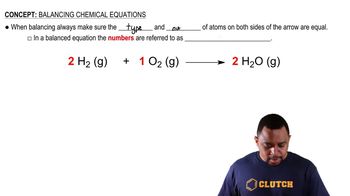
Balancing Chemical Equations

Balancing chemical equations involves ensuring that the number of atoms for each element is the same on both the reactant and product sides. This is based on the law of conservation of mass, which states that matter cannot be created or destroyed in a chemical reaction. A balanced equation provides a clear representation of the reactants and products involved in a reaction.
추천 영상:
가이드 코스
01:32
Balancing Chemical Equations

Molecular and Net Ionic Equations

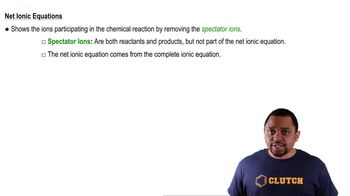
A molecular equation shows the complete chemical formulas of reactants and products, while a net ionic equation focuses on the species that actually participate in the reaction, omitting spectator ions. To derive the net ionic equation, one must first write the balanced molecular equation, then dissociate the soluble ionic compounds into their respective ions, and finally eliminate the spectator ions to reveal the core reaction.
추천 영상:
가이드 코스
00:51
Net Ionic Equations

Gas Formation in Reactions

Gas formation in chemical reactions often indicates a change in state and can be identified by observing the production of bubbles or effervescence. In the context of acid-base reactions, gases such as hydrogen sulfide or carbon dioxide may be produced. Recognizing the gas formed is crucial for understanding the reaction's dynamics and the products involved.
추천 영상:
가이드 코스
02:34
Enthalpy of Formation