
Ch.4 - Reactions in Aqueous Solution
Brown - Chemistry: The Central Science 14th Edition
Brown14th EditionChemistry: The Central ScienceISBN: 9780134414232당신이 사용하는 게 아니라요?교과서 변경
4장, 문제 54a,b

Write balanced molecular and net ionic equations for the reactions of (a) hydrochloric acid with nickel (b) dilute sulfuric acid with iron

검증된 단계별 안내
1
Identify the reactants: Dilute sulfuric acid (H2SO4) and iron (Fe).
Write the unbalanced molecular equation: H2SO4(aq) + Fe(s) → FeSO4(aq) + H2(g).
Balance the molecular equation: H2SO4(aq) + Fe(s) → FeSO4(aq) + H2(g). Since there is one sulfate ion (SO4^2-) and one iron atom on both sides, and two hydrogen atoms on both sides, the equation is balanced as written.
Write the total ionic equation by breaking all soluble strong electrolytes into their ions: H2SO4(aq) + Fe(s) → Fe^2+(aq) + SO4^2-(aq) + H2(g).
Identify and remove the spectator ions (ions that appear on both sides of the equation in the same form) to write the net ionic equation. In this case, the sulfate ion is a spectator ion: Fe(s) + 2H+(aq) → Fe^2+(aq) + H2(g).

비슷한 문제에 대한 검증된 영상 답변:

이 영상 해법은 위 문제에 도움이 된다고 튜터들이 추천한 것입니다.
영상 길이:
3m
도움이 되었나요?

주요 개념

질문에 올바르게 답하기 위해 반드시 이해해야 하는 핵심 개념들은 다음과 같습니다.

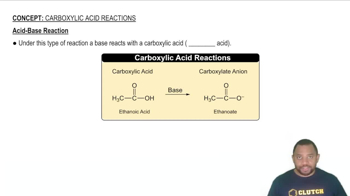
Acid-Base Reactions

Acid-base reactions involve the transfer of protons (H+) between reactants. In this context, sulfuric acid (H2SO4) acts as an acid, donating protons to iron (Fe), which can accept them. Understanding this concept is crucial for predicting the products of the reaction and writing balanced equations.
추천 영상:
가이드 코스
01:09
Acid-Base Reaction

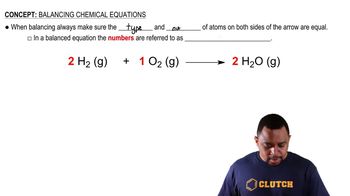
Balancing Chemical Equations

Balancing chemical equations ensures that the number of atoms for each element is the same on both sides of the equation, adhering to the law of conservation of mass. This process involves adjusting coefficients in front of compounds to achieve balance, which is essential for accurately representing the stoichiometry of the reaction.
추천 영상:
가이드 코스
01:32
Balancing Chemical Equations

Net Ionic Equations

Net ionic equations focus on the species that actually participate in a chemical reaction, omitting spectator ions that do not change during the reaction. This concept is important for simplifying reactions in aqueous solutions, allowing for a clearer understanding of the underlying chemical processes.
추천 영상:
가이드 코스
00:51
Net Ionic Equations
관련 실천
교과서 질문

Which of the following are redox reactions? For those that are, indicate which element is oxidized and which is reduced. For those that are not, indicate whether they are precipitation or neutralization reactions. (a) P4(s) + 10 HClO(aq) + 6 H2O(l) → 4 H3PO4(aq) + 10 HCl(aq) (b) Br2(l) + 2 K(s)→ 2 KBr(s) (c) CH3CH2OH(l) + 3 O2(g) → 3 H2O(l) + 2 CO2(g) (d) ZnCl2(aq) + 2 NaOH(aq) → Zn(OH)2(s) + 2 NaCl(aq)

657
views
교과서 질문

Using the activity series (Table 4.5), write balanced chemical equations for the following reactions. If no reaction occurs, write NR. (a) Iron metal is added to a solution of copper(II) nitrate (b) zinc metal is added to a solution of magnesium sulfate

756
views
교과서 질문

Which element is oxidized, and which is reduced in the following reactions? (c) Cl2(aq) + 2 NaI(aq) → I2(aq) + 2 NaCl(aq) (d) PbS(s) + 4 H2O2(aq) → PbSO4(s) + 4 H2O(l)

718
views
교과서 질문

Write balanced molecular and net ionic equations for the reactions of (c) hydrobromic acid with magnesium (d) acetic acid, CH3COOH, with zinc.

473
views
교과서 질문

Write balanced molecular and net ionic equations for the reactions of (a) manganese with dilute sulfuric acid (b) chromium with hydrobromic acid (c) tin with hydrochloric acid (d) aluminum with formic acid, HCOOH.

751
views
교과서 질문

Using the activity series (Table 4.5), write balanced chemical equations for the following reactions. If no reaction occurs, write NR. (c) hydrobromic acid is added to tin metal

545
views