Which ions remain in solution, unreacted, after each of the following pairs of solutions is mixed? (c) ammonium phosphate and calcium chloride
Ch.4 - Reactions in Aqueous Solution
4장, 문제 26a,b
Write balanced net ionic equations for the reactions that occur in each of the following cases. Identify the spectator ion or ions in each reaction.
(a) Ba(OH)2(aq) + FeCl3(aq) →
(b) ZnCl2(aq) + Cs2CO3(aq) →
검증된 단계별 안내1
Identify the reactants: Barium hydroxide \((\text{Ba(OH)}_2)\) and Iron(III) chloride \((\text{FeCl}_3)\).
Determine the products of the reaction: Barium chloride \((\text{BaCl}_2)\) and Iron(III) hydroxide \((\text{Fe(OH)}_3)\).
Write the balanced molecular equation: \(\text{Ba(OH)}_2(aq) + \text{FeCl}_3(aq) \rightarrow \text{BaCl}_2(aq) + \text{Fe(OH)}_3(s)\).
Write the complete ionic equation by dissociating all strong electrolytes: \(\text{Ba}^{2+}(aq) + 2\text{OH}^-(aq) + \text{Fe}^{3+}(aq) + 3\text{Cl}^-(aq) \rightarrow \text{Ba}^{2+}(aq) + 2\text{Cl}^-(aq) + \text{Fe(OH)}_3(s)\).
Identify and remove the spectator ions (ions that appear on both sides of the equation): \(\text{Ba}^{2+}\) and \(\text{Cl}^-\). Write the net ionic equation: \(\text{Fe}^{3+}(aq) + 3\text{OH}^-(aq) \rightarrow \text{Fe(OH)}_3(s)\).

비슷한 문제에 대한 검증된 영상 답변:
이 영상 해법은 위 문제에 도움이 된다고 튜터들이 추천한 것입니다.
영상 길이:
7m도움이 되었나요?
주요 개념
질문에 올바르게 답하기 위해 반드시 이해해야 하는 핵심 개념들은 다음과 같습니다.
Net Ionic Equations
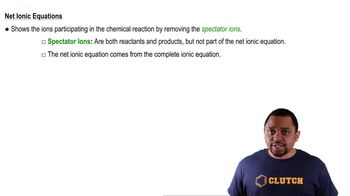
Net ionic equations represent the actual chemical species that participate in a reaction, excluding spectator ions. To write a net ionic equation, one must first write the balanced molecular equation, then dissociate all soluble strong electrolytes into their ions, and finally eliminate the spectator ions that do not change during the reaction.
추천 영상:
가이드 코스
Net Ionic Equations
Spectator Ions
Spectator ions are ions that exist in the same form on both the reactant and product sides of a chemical equation. They do not participate in the actual chemical reaction and can be removed from the net ionic equation. Identifying spectator ions is crucial for simplifying the equation to focus on the species that undergo a change.
추천 영상:
가이드 코스
Ion Formation
Solubility Rules
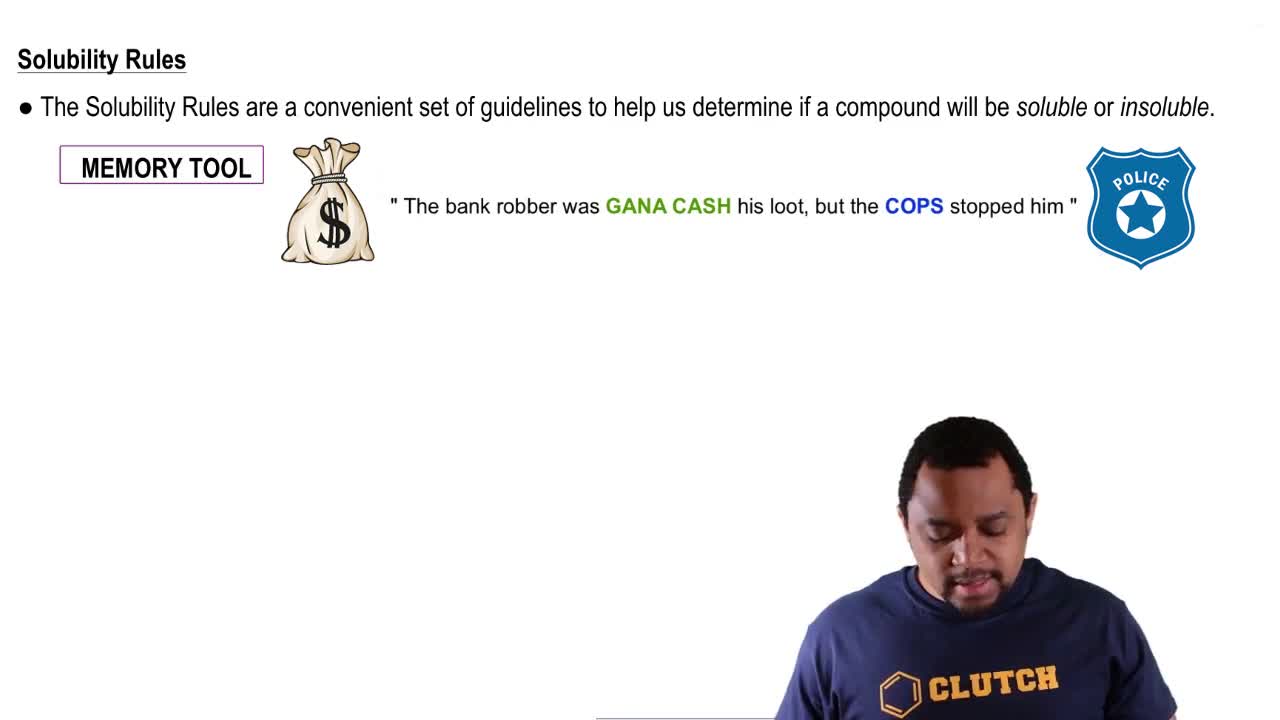
Solubility rules help predict whether a compound will dissolve in water or form a precipitate. These rules are based on the nature of the ions involved and their interactions. Understanding solubility is essential for determining which compounds dissociate into ions in solution and which remain intact, influencing the formation of net ionic equations.
추천 영상:
가이드 코스
Solubility Rules
관련 실천
교과서 질문
904
views
교과서 질문
Separate samples of a solution of an unknown ionic compound are treated with dilute AgNO3, Pb1NO322, and BaCl2. Precipitates form in all three cases. Which of the following could be the anion of the unknown salt: Br-, CO32-, NO3-?
1171
views
교과서 질문
Identify the precipitate (if any) that forms when the following solutions are mixed, and write a balanced equation for each reaction. (a) NH4I and CuCl2 (b) LiOH and MnCl2 (c) K3PO4 and CoSO4
1007
views
교과서 질문
Which ions remain in solution, unreacted, after each of the following pairs of solutions is mixed? (a) potassium carbonate and magnesium sulfate
646
views
교과서 질문
Write balanced net ionic equations for the reactions that occur in each of the following cases. Identify the spectator ion or ions in each reaction. (c) Na2S(aq) + CoSO4(aq) →
605
views