
Ch.5 - Thermochemistry
Brown - Chemistry: The Central Science 14th Edition
Brown14th EditionChemistry: The Central ScienceISBN: 9780134414232당신이 사용하는 게 아니라요?교과서 변경
5장, 문제 58b

A 2.20-g sample of phenol (C6H5OH) was burned in a bomb calorimeter whose total heat capacity is 11.90 kJ/°C. The temperature of the calorimeter plus contents increased from 21.50 to 27.50 °C. (b) What is the heat of combustion per mole of phenol?

검증된 단계별 안내
1
Calculate the temperature change (\( \Delta T \)) of the calorimeter by subtracting the initial temperature from the final temperature: \( \Delta T = T_{\text{final}} - T_{\text{initial}} \).
Use the formula for heat absorbed by the calorimeter: \( q = C_{\text{cal}} \times \Delta T \), where \( C_{\text{cal}} \) is the heat capacity of the calorimeter.
Determine the moles of phenol burned using its molar mass: \( \text{moles of phenol} = \frac{\text{mass of phenol}}{\text{molar mass of phenol}} \).
Calculate the heat of combustion per mole of phenol by dividing the total heat absorbed by the calorimeter by the moles of phenol: \( \Delta H_{\text{combustion}} = \frac{q}{\text{moles of phenol}} \).
Ensure the sign of \( \Delta H_{\text{combustion}} \) is negative, as combustion is an exothermic process.

비슷한 문제에 대한 검증된 영상 답변:

이 영상 해법은 위 문제에 도움이 된다고 튜터들이 추천한 것입니다.
영상 길이:
4m
도움이 되었나요?

주요 개념

질문에 올바르게 답하기 위해 반드시 이해해야 하는 핵심 개념들은 다음과 같습니다.

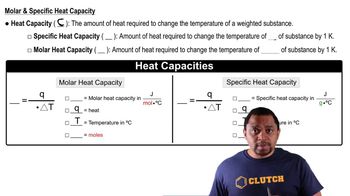
Heat Capacity

Heat capacity is the amount of heat required to change the temperature of a substance by one degree Celsius. In calorimetry, the heat capacity of the calorimeter is crucial for determining the total heat absorbed or released during a reaction. It is calculated by multiplying the heat capacity by the change in temperature, allowing us to quantify the energy changes involved in the combustion process.
추천 영상:

Molar Mass

Molar mass is the mass of one mole of a substance, typically expressed in grams per mole (g/mol). For phenol (C6H5OH), the molar mass can be calculated by summing the atomic masses of its constituent elements. Knowing the molar mass is essential for converting the mass of phenol burned into moles, which is necessary for calculating the heat of combustion per mole.
추천 영상:
가이드 코스
02:11
Molar Mass Concept

Heat of Combustion

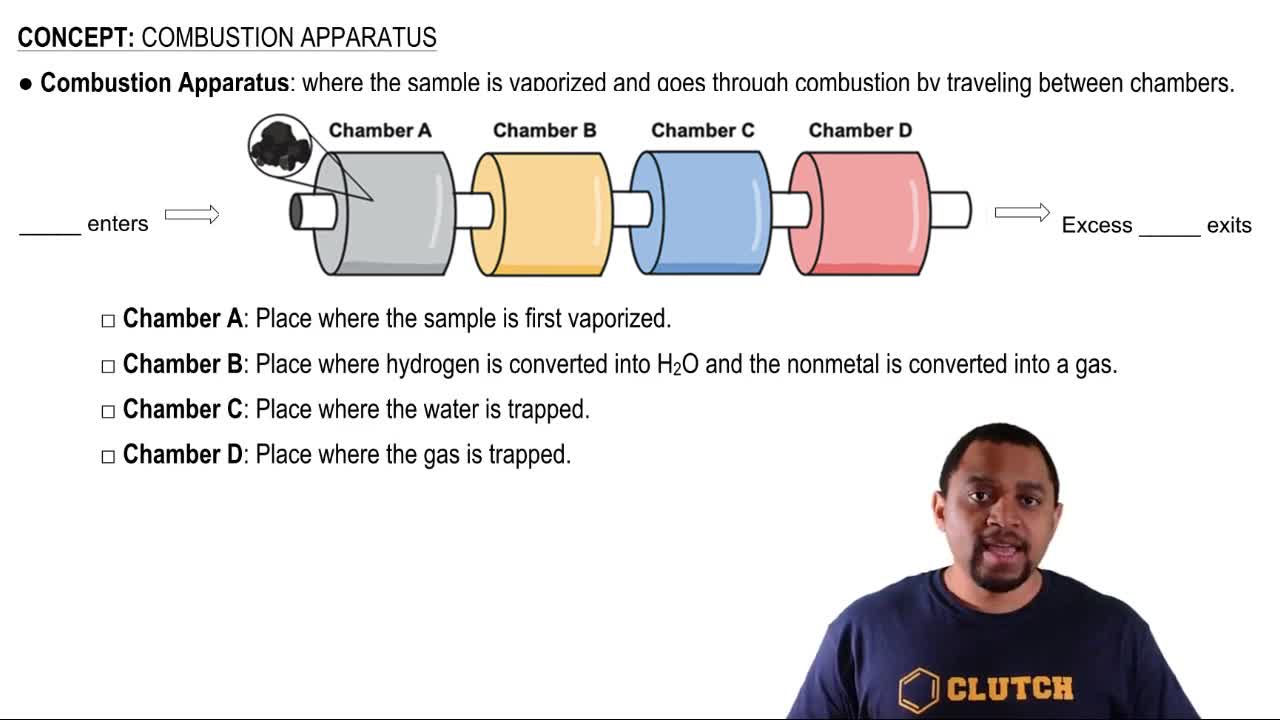
The heat of combustion is the amount of energy released when one mole of a substance is completely burned in oxygen. It is typically expressed in kilojoules per mole (kJ/mol). To find the heat of combustion for phenol, the total heat released during the combustion process, calculated from the calorimeter's temperature change, is divided by the number of moles of phenol burned, providing a measure of the energy content of the fuel.
추천 영상:
가이드 코스
02:24
Combustion Apparatus
관련 실천
교과서 질문

A 1.50-g sample of quinone (C6H4O2) is burned in a bomb calorimeter whose total heat capacity is 8.500 kJ/°C. The temperature of the calorimeter increases from 25.00 to 29.49 °C. (a) Write a balanced chemical equation for the bomb calorimeter reaction.

350
views
교과서 질문

Under constant-volume conditions, the heat of combustion of benzoic acid (C6H5O6) is 15.57 kJ/g. A 3.500-g sample of sucrose is burned in a bomb calorimeter. The temperature of the calorimeter increases from 20.94 to 24.72 °C. (a) What is the total heat capacity of the calorimeter?

1939
views
교과서 질문

Under constant-volume conditions, the heat of combustion of benzoic acid (C6H5O6) is 15.57 kJ/g. A 3.500-g sample of sucrose is burned in a bomb calorimeter. The temperature of the calorimeter increases from 20.94 to 24.72 °C. (b) If the size of the sucrose sample had been exactly twice as large, what would the temperature change of the calorimeter have been?

1040
views
교과서 질문

Under constant-volume conditions, the heat of combustion of naphthalene (C10H8) is 40.18 kJ/g. A 2.50-g sample of naphthalene is burned in a bomb calorimeter. The temperature of the calorimeter increases from 21.50 to 28.83 °C. (c) Suppose that in changing samples, a portion of the water in the calorimeter were lost. In what way, if any, would this change the heat capacity of the calorimeter?

1165
views
교과서 질문

A 1.50-g sample of quinone (C6H4O2) is burned in a bomb calorimeter whose total heat capacity is 8.500 kJ/°C. The temperature of the calorimeter increases from 25.00 to 29.49°C. (b) What is the heat of combustion per gram of quinone and per mole of quinone?

1448
views
교과서 질문

A 2.20-g sample of phenol (C6H5OH) was burned in a bomb calorimeter whose total heat capacity is 11.90 kJ/°C. The temperature of the calorimeter plus contents increased from 21.50 to 27.50 °C. (a) Write a balanced chemical equation for the bomb calorimeter reaction.

704
views