Ch.5 - Thermochemistry
Brown - Chemistry: The Central Science 14th Edition
Brown14th EditionChemistry: The Central ScienceISBN: 9780134414232당신이 사용하는 게 아니라요?교과서 변경
5장, 문제 34

(a) Under what condition will the enthalpy change of a process equal the amount of heat transferred into or out of the system? (b) During a constant-pressure process, the system releases heat to the surroundings. Does the enthalpy of the system increase or decrease during the process? (c) In a constant-pressure process, _x001F_H = 0. What can you conclude about _x001F_E, q, and w?

검증된 단계별 안내
1
Step 1: Understand the relationship between enthalpy change (ΔH) and heat transfer (q) in thermodynamics. Enthalpy change equals the heat transferred into or out of the system at constant pressure. Therefore, ΔH = q when the process occurs at constant pressure.
Step 2: For part (b), consider the scenario where the system releases heat to the surroundings at constant pressure. According to the first law of thermodynamics, if the system releases heat, q is negative. Since ΔH = q at constant pressure, the enthalpy of the system decreases.
Step 3: For part (c), analyze the condition where ΔH = 0 in a constant-pressure process. This implies that there is no net heat transfer into or out of the system, meaning q = 0.
Step 4: Use the first law of thermodynamics, ΔE = q + w, where ΔE is the change in internal energy and w is the work done on or by the system. Since q = 0, ΔE = w.
Step 5: Conclude that if ΔH = 0 and q = 0, then the work done (w) is the only contributor to the change in internal energy (ΔE). Therefore, ΔE = w, indicating that any change in internal energy is due to work done on or by the system.

주요 개념

질문에 올바르게 답하기 위해 반드시 이해해야 하는 핵심 개념들은 다음과 같습니다.

Enthalpy (H)

Enthalpy is a thermodynamic property that represents the total heat content of a system. It is defined as the sum of the internal energy of the system plus the product of its pressure and volume (H = U + PV). In constant-pressure processes, the change in enthalpy (ΔH) is equal to the heat exchanged (q) with the surroundings, making it a crucial concept for understanding heat transfer in chemical reactions.
추천 영상:
가이드 코스
02:34
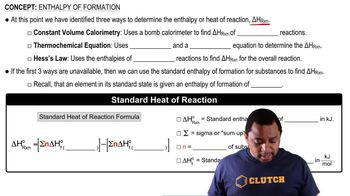
Enthalpy of Formation

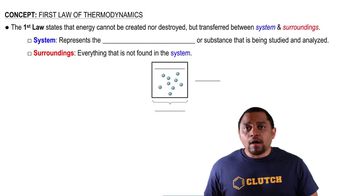
First Law of Thermodynamics

The First Law of Thermodynamics states that energy cannot be created or destroyed, only transformed from one form to another. In the context of a chemical process, this means that the change in internal energy (ΔE) of a system is equal to the heat added to the system (q) minus the work done by the system (w), expressed as ΔE = q - w. This principle is essential for analyzing energy changes during chemical reactions.
추천 영상:
가이드 코스
01:18
First Law of Thermodynamics

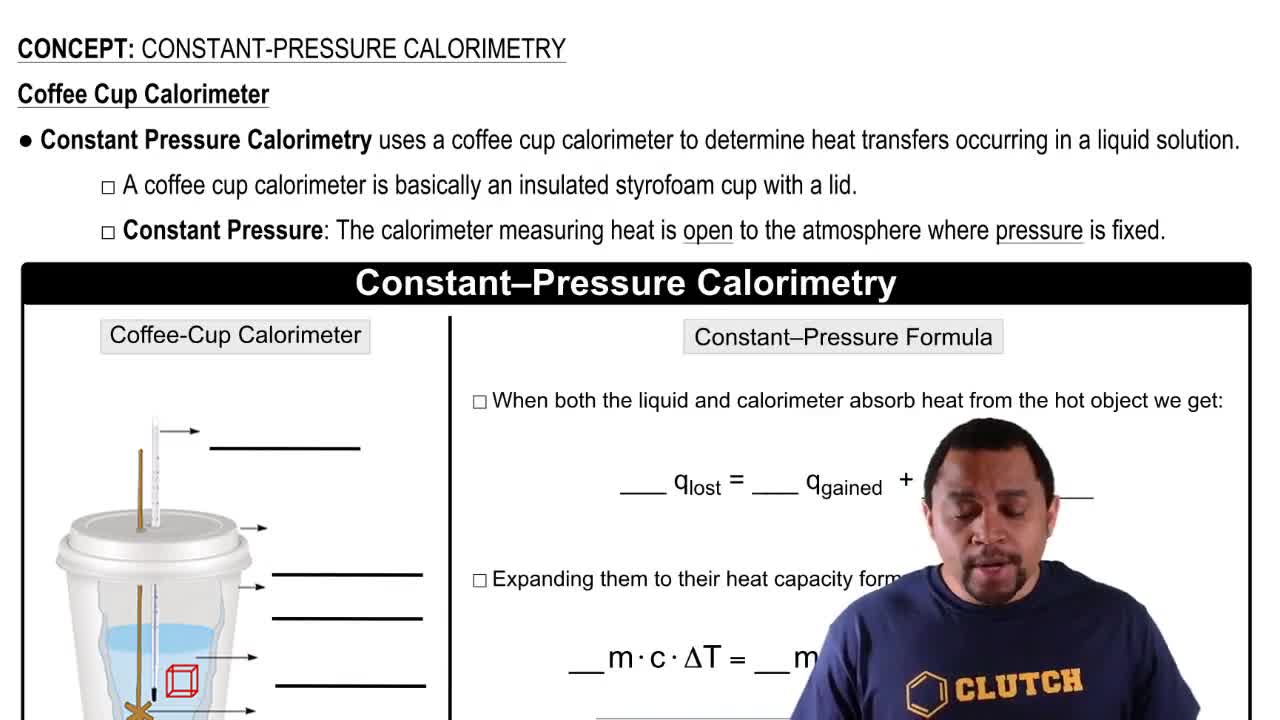
Constant-Pressure Process

A constant-pressure process is a thermodynamic process that occurs at a fixed pressure, allowing for the direct relationship between heat transfer and enthalpy change. In such processes, if the system releases heat (q < 0), the enthalpy of the system decreases (ΔH < 0). Understanding this relationship is vital for predicting how energy changes affect the state of a system during chemical reactions.
추천 영상:
가이드 코스
02:35
Constant-Pressure Calorimetry