Ch.5 - Thermochemistry
Brown - Chemistry: The Central Science 14th Edition
Brown14th EditionChemistry: The Central ScienceISBN: 9780134414232당신이 사용하는 게 아니라요?교과서 변경
5장, 문제 89

(a) What is meant by the term fuel value? (b) Which is a greater source of energy as food, 5 g of fat or 9 g of carbohydrate?

검증된 단계별 안내
1
Step 1: Understand the term 'fuel value'. In chemistry, the fuel value refers to the amount of energy released when a substance is completely combusted. It is usually expressed in units of energy per mass, such as kilojoules per gram (kJ/g) or calories per gram (cal/g).
Step 2: Identify the typical fuel values for fats and carbohydrates. Fats generally have a higher fuel value, approximately 9 kcal/g, while carbohydrates have a fuel value of about 4 kcal/g.
Step 3: Calculate the total energy provided by 5 g of fat. Multiply the mass of the fat by its fuel value: 5 g * 9 kcal/g.
Step 4: Calculate the total energy provided by 9 g of carbohydrate. Multiply the mass of the carbohydrate by its fuel value: 9 g * 4 kcal/g.
Step 5: Compare the total energy values obtained from the calculations in Steps 3 and 4 to determine which provides a greater source of energy.

주요 개념

질문에 올바르게 답하기 위해 반드시 이해해야 하는 핵심 개념들은 다음과 같습니다.

Fuel Value

Fuel value refers to the amount of energy that can be obtained from a substance when it is metabolized. It is typically measured in calories or joules and varies among different macromolecules such as carbohydrates, fats, and proteins. Understanding fuel value is essential for evaluating the energy content of foods and their role in nutrition.
추천 영상:
가이드 코스
01:56
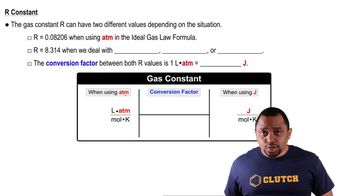
Gas Constant Values

Energy Content of Macronutrients

Different macronutrients provide varying amounts of energy per gram. Fats yield approximately 9 calories per gram, while carbohydrates provide about 4 calories per gram. This difference in energy content is crucial for determining which food source is more energy-dense and can supply more energy for metabolic processes.
추천 영상:
가이드 코스
01:26
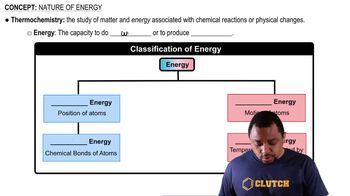
Nature of Energy

Comparative Energy Calculation

To compare the energy provided by different food sources, one must calculate the total energy from each source based on their mass and respective energy content. For example, 5 g of fat would provide 45 calories (5 g x 9 cal/g), while 9 g of carbohydrates would yield 36 calories (9 g x 4 cal/g). This calculation helps in understanding which food source is more efficient in providing energy.
추천 영상:
가이드 코스
01:51
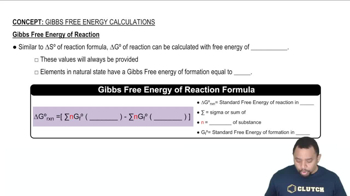
Gibbs Free Energy of Reactions