Ch.5 - Thermochemistry
Brown - Chemistry: The Central Science 14th Edition
Brown14th EditionChemistry: The Central ScienceISBN: 9780134414232당신이 사용하는 게 아니라요?교과서 변경
5장, 문제 14a

(a) What is the electrostatic potential energy (in joules) between two electrons that are separated by 62 pm?

검증된 단계별 안내
1
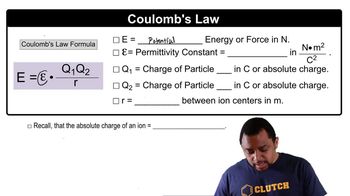
Identify the formula for electrostatic potential energy between two point charges, which is given by Coulomb's Law: \( U = \frac{k \cdot q_1 \cdot q_2}{r} \), where \( U \) is the potential energy, \( k \) is Coulomb's constant (\( 8.99 \times 10^9 \, \text{N m}^2/\text{C}^2 \)), \( q_1 \) and \( q_2 \) are the charges, and \( r \) is the separation between the charges.
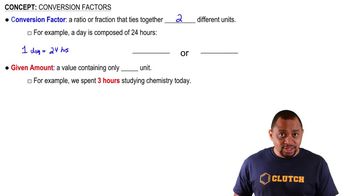
Convert the distance from picometers to meters. Since 1 pm = \( 1 \times 10^{-12} \) meters, multiply 62 pm by \( 1 \times 10^{-12} \) to convert it to meters.
Substitute the values of the charges of the electrons, which are both \( -1.602 \times 10^{-19} \) Coulombs, into the formula.
Plug in the value of \( r \) (the converted distance in meters) and the Coulomb's constant into the formula.
Calculate the electrostatic potential energy using the values substituted into the formula. Remember that the result will be negative, indicating that the potential energy is attractive.

비슷한 문제에 대한 검증된 영상 답변:

이 영상 해법은 위 문제에 도움이 된다고 튜터들이 추천한 것입니다.
영상 길이:
3m
도움이 되었나요?

주요 개념

질문에 올바르게 답하기 위해 반드시 이해해야 하는 핵심 개념들은 다음과 같습니다.

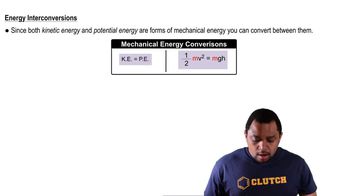
Electrostatic Potential Energy

Electrostatic potential energy is the energy stored due to the position of charged particles relative to each other. It is calculated using the formula U = k * (q1 * q2) / r, where U is the potential energy, k is Coulomb's constant, q1 and q2 are the charges, and r is the distance between them. For electrons, which have the same charge, this energy will be negative, indicating a repulsive interaction.
추천 영상:
가이드 코스
00:34
Kinetic & Potential Energy

Coulomb's Law

Coulomb's Law describes the force between two charged objects and is fundamental in calculating electrostatic interactions. It states that the force (F) between two charges is directly proportional to the product of the magnitudes of the charges and inversely proportional to the square of the distance between them. This law is essential for determining the potential energy in systems involving charged particles.
추천 영상:
가이드 코스
01:15
Coulomb's Law Concept 2

Unit Conversion

In chemistry and physics, unit conversion is crucial for ensuring that measurements are in compatible units. In this context, the distance between the electrons is given in picometers (pm), which must be converted to meters (m) for calculations involving electrostatic potential energy. Understanding how to convert units accurately is vital for obtaining correct results in scientific calculations.
추천 영상:
가이드 코스
01:56
Conversion Factors