
For each of the following compounds, write a balanced thermochemical equation depicting the formation of one mole of the compound from its elements in their standard states and then look up ΔH°f for each substance in Appendix C. (a) NO2(g) (b) SO3(g) (c) NaBr(s) (d) Pb(NO3)2(s).
Ch.5 - Thermochemistry
5장, 문제 68
(a) Why does the standard enthalpy of formation of both the very reactive fluorine (F2) and the almost inert gas nitrogen (N2) both read zero?
검증된 단계별 안내1
Understand that the standard enthalpy of formation is defined as the change in enthalpy when one mole of a substance is formed from its elements in their standard states.
Recognize that the standard state of an element is its most stable form at 1 atmosphere of pressure and a specified temperature, usually 25°C (298 K).
Note that for any element in its standard state, the standard enthalpy of formation is defined to be zero because no formation reaction is needed to produce the element from itself.
Identify that both fluorine (F_2) and nitrogen (N_2) are in their most stable forms as diatomic molecules under standard conditions.
Conclude that since F_2 and N_2 are in their standard states, their standard enthalpies of formation are zero by definition.

비슷한 문제에 대한 검증된 영상 답변:
이 영상 해법은 위 문제에 도움이 된다고 튜터들이 추천한 것입니다.
영상 길이:
55s도움이 되었나요?
주요 개념
질문에 올바르게 답하기 위해 반드시 이해해야 하는 핵심 개념들은 다음과 같습니다.
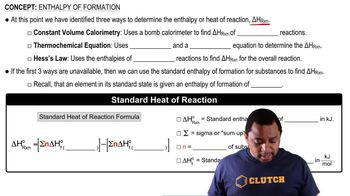
Standard Enthalpy of Formation
The standard enthalpy of formation is defined as the change in enthalpy when one mole of a compound is formed from its elements in their standard states. For elements in their standard state, such as F<sub>2</sub> and N<sub>2</sub>, the standard enthalpy of formation is assigned a value of zero. This serves as a reference point for calculating the enthalpy changes of reactions involving these elements.
추천 영상:
가이드 코스
Enthalpy of Formation
Standard State
The standard state of a substance is its physical state at a defined set of conditions, typically 1 bar of pressure and a specified temperature, usually 25°C. For diatomic gases like F<sub>2</sub> and N<sub>2</sub>, their standard state is the gaseous form at these conditions. Understanding standard states is crucial for interpreting thermodynamic data and calculating reaction enthalpies.
추천 영상:
가이드 코스
Standard Reduction Potentials
Reactivity and Stability of Elements
Reactivity refers to how readily a substance undergoes chemical reactions, while stability indicates how likely it is to remain unchanged. Fluorine (F<sub>2</sub>) is highly reactive due to its strong electronegativity and tendency to form bonds, whereas nitrogen (N<sub>2</sub>) is relatively inert due to the strong triple bond between nitrogen atoms. Despite their differences in reactivity, both elements have a standard enthalpy of formation of zero because they are in their elemental forms.
추천 영상:
가이드 코스
Intepreting the Band of Stability
관련 실천
교과서 질문
1051
views
교과서 질문
Given the data N2(g) + O2(g) → 2 NO(g) ΔH = +180.7 kJ 2 NO(g) + O2(g) → 2 NO2(g) ΔH = -113.1 kJ 2 N2O(g) → 2 N2(g) + O2(g) ΔH = -163.2 kJ use Hess's law to calculate ΔH for the reaction N2O(g) + NO2(g) → 3 NO(g)
894
views
교과서 질문
Write balanced equations that describe the formation of the following compounds from elements in their standard states, and then look up the standard enthalpy of formation for each substance in Appendix C: (a) CH3OH(l)
1009
views
1
rank
교과서 질문
From the enthalpies of reaction H2(g) + F2(g) → 2 HF(g) ΔH = -537 kJ C(s) + 2 F2(g) → CF4(g) ΔH = -680 kJ 2 C(s) + 2 H2(g) → C2H4(g) ΔH = +52.3 kJ Calculate H for the reaction of ethylene with F2: C2H4(g) + 6 F2(g) → 2 CF4(g) + 4 HF(g)
971
views
교과서 질문
(c) What is meant by the term standard enthalpy of formation?
456
views
