
Ch.5 - Thermochemistry
Brown - Chemistry: The Central Science 14th Edition
Brown14th EditionChemistry: The Central ScienceISBN: 9780134414232당신이 사용하는 게 아니라요?교과서 변경
5장, 문제 118c

At 25 °C (approximately room temperature) the rms velocity of an Ar atom in air is 1553 km/h. (c) What is the total kinetic energy of 1 mol of Ar atoms moving at this speed?

검증된 단계별 안내
1
First, convert the rms velocity from km/h to m/s. Since 1 km/h is equal to 0.27778 m/s, multiply 1553 km/h by 0.27778 to get the velocity in m/s.
Use the formula for kinetic energy of a single particle: \( KE = \frac{1}{2} m v^2 \), where \( m \) is the mass of one Ar atom and \( v \) is the velocity in m/s. The mass of one Ar atom can be found using the molar mass of Ar (approximately 39.95 g/mol) and Avogadro's number (\( 6.022 \times 10^{23} \) atoms/mol).
Convert the molar mass of Ar from grams to kilograms by dividing by 1000, since 1 g = 0.001 kg. Then, calculate the mass of one Ar atom by dividing the molar mass in kg by Avogadro's number.
Substitute the mass of one Ar atom and the velocity in m/s into the kinetic energy formula to find the kinetic energy of one Ar atom.
Finally, multiply the kinetic energy of one Ar atom by Avogadro's number to find the total kinetic energy of 1 mol of Ar atoms moving at the given speed.

비슷한 문제에 대한 검증된 영상 답변:

이 영상 해법은 위 문제에 도움이 된다고 튜터들이 추천한 것입니다.
영상 길이:
4m

주요 개념

질문에 올바르게 답하기 위해 반드시 이해해야 하는 핵심 개념들은 다음과 같습니다.

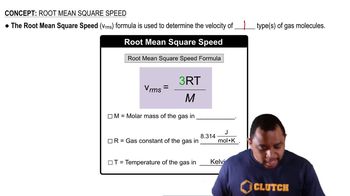
Root Mean Square Velocity (rms velocity)

The root mean square velocity is a measure of the average speed of particles in a gas. It is calculated using the formula v_rms = sqrt(3RT/M), where R is the ideal gas constant, T is the temperature in Kelvin, and M is the molar mass of the gas. This concept is crucial for understanding the kinetic energy of gas particles, as it relates directly to their motion and energy.
추천 영상:
가이드 코스
01:05
Root Mean Square Speed Formula

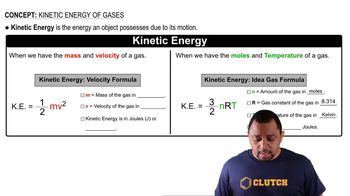
Kinetic Energy of Gas Particles

The kinetic energy of gas particles is given by the equation KE = (1/2)mv^2, where m is the mass of a particle and v is its velocity. For a mole of gas, the total kinetic energy can also be expressed as KE_total = (3/2)nRT, where n is the number of moles, R is the ideal gas constant, and T is the temperature. This relationship highlights how temperature and the number of particles influence the overall energy of a gas.
추천 영상:
가이드 코스
02:27
Kinetic Energy Formulas

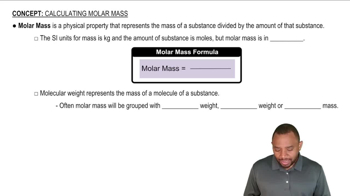
Molar Mass

Molar mass is the mass of one mole of a substance, typically expressed in grams per mole (g/mol). For argon (Ar), the molar mass is approximately 40 g/mol. Understanding molar mass is essential for converting between the mass of a substance and the number of moles, which is necessary for calculating kinetic energy and other properties in gas laws.
추천 영상:
가이드 코스
02:11
Molar Mass Concept