Ch.5 - Thermochemistry
Brown - Chemistry: The Central Science 14th Edition
Brown14th EditionChemistry: The Central ScienceISBN: 9780134414232당신이 사용하는 게 아니라요?교과서 변경
5장, 문제 49b

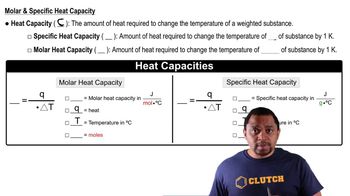
(b) The specific heat of aluminum is 0.9 J/(g - K). Calculate its molar heat capacity.

검증된 단계별 안내
1
Determine the molar mass of aluminum, which is approximately 26.98 g/mol.
Understand that the specific heat capacity (c) is given in J/(g\(\cdot\) K), which means it is the energy required to raise the temperature of 1 gram of the substance by 1 Kelvin.
Recognize that molar heat capacity (C) is the energy required to raise the temperature of one mole of a substance by 1 Kelvin.
Use the formula for molar heat capacity: C = c \(\times\) molar mass. Here, c is the specific heat capacity and the molar mass is the mass of one mole of the substance.
Substitute the values into the formula: C = 0.9 \, \(\text{J/(g\cdot K)}\) \(\times\) 26.98 \, \(\text{g/mol}\).

비슷한 문제에 대한 검증된 영상 답변:

이 영상 해법은 위 문제에 도움이 된다고 튜터들이 추천한 것입니다.
영상 길이:
53s

주요 개념

질문에 올바르게 답하기 위해 반드시 이해해야 하는 핵심 개념들은 다음과 같습니다.

Specific Heat Capacity

Specific heat capacity is the amount of heat required to raise the temperature of one gram of a substance by one degree Celsius (or one Kelvin). It is a material-specific property that indicates how much energy a substance can store per unit mass. In this case, aluminum has a specific heat of 0.9 J/(g·K), meaning it requires 0.9 joules of energy to increase the temperature of one gram of aluminum by one Kelvin.
추천 영상:

Molar Heat Capacity

Molar heat capacity is the amount of heat required to raise the temperature of one mole of a substance by one degree Celsius (or one Kelvin). It is calculated by multiplying the specific heat capacity by the molar mass of the substance. For aluminum, to find its molar heat capacity, we need to use its specific heat and the molar mass, which is approximately 27 g/mol.
추천 영상:

Conversion from Specific Heat to Molar Heat Capacity

To convert specific heat capacity to molar heat capacity, the formula used is: Molar Heat Capacity = Specific Heat Capacity × Molar Mass. This relationship allows us to express the heat capacity in terms of moles rather than grams, which is particularly useful in chemical reactions and thermodynamic calculations. For aluminum, this conversion will yield the molar heat capacity in J/(mol·K).
추천 영상:
관련 실천
교과서 질문

(a) What amount of heat (in joules) is required to raise the temperature of 1 g of water by 1 kelvin? (b) What amount of heat (in joules) is required to raise the temperature of 1 mole of water by 1 kelvin?

교과서 질문

Two solid objects, A and B, are placed in boiling water and allowed to come to the temperature of the water. Each is then lifted out and placed in separate beakers containing 1000 g of water at 10.0 °C. Object A increases the water temperature by 3.50 °C; B increases the water temperature by 2.60 °C. (b) What can you say about the specific heats of A and B?

교과서 질문

Consider the decomposition of liquid benzene, C6H6(l), to gaseous acetylene, C2H2(g): C6H6(l) → 3 C2H2(g) ΔH = +630 kJ (c) Which is more likely to be thermodynamically favored, the forward reaction or the reverse reaction?

344
views
교과서 질문

Two solid objects, A and B, are placed in boiling water and allowed to come to the temperature of the water. Each is then lifted out and placed in separate beakers containing 1000 g of water at 10.0 °C. Object A increases the water temperature by 3.50 °C; B increases the water temperature by 2.60 °C. (a) Which object has the larger heat capacity?

1585
views
1
rank
교과서 질문

Consider the decomposition of liquid benzene, C6H6(l), to gaseous acetylene, C2H2(g): C6H6(l) → 3 C2H2(g) ΔH = +630 kJ (d) If C6H6(g) were consumed instead of C6H6(l), would you expect the magnitude of ΔH to increase, decrease, or stay the same? Explain.

682
views