
교과서 질문
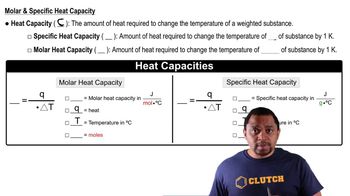
(a) What amount of heat (in joules) is required to raise the temperature of 1 g of water by 1 kelvin? (b) What amount of heat (in joules) is required to raise the temperature of 1 mole of water by 1 kelvin?

 검증된 단계별 안내
 02:19
02:19 02:19 02:19
(a) What amount of heat (in joules) is required to raise the temperature of 1 g of water by 1 kelvin? (b) What amount of heat (in joules) is required to raise the temperature of 1 mole of water by 1 kelvin?
Two solid objects, A and B, are placed in boiling water and allowed to come to the temperature of the water. Each is then lifted out and placed in separate beakers containing 1000 g of water at 10.0 °C. Object A increases the water temperature by 3.50 °C; B increases the water temperature by 2.60 °C. (b) What can you say about the specific heats of A and B?
The specific heat of octane, C8H18(l), is 2.22 J•g/K. (a) How many J of heat are needed to raise the temperature of 80.0 g of octane from 10.0 to 25.0 °C?
Two solid objects, A and B, are placed in boiling water and allowed to come to the temperature of the water. Each is then lifted out and placed in separate beakers containing 1000 g of water at 10.0 °C. Object A increases the water temperature by 3.50 °C; B increases the water temperature by 2.60 °C. (a) Which object has the larger heat capacity?
(d) How many kJ of heat are needed to raise the temperature of 5.00 kg of liquid water from 24.6 to 46.2 °C?
(b) Calculate the energy needed for this temperature change.