
Ch.5 - Thermochemistry
Brown - Chemistry: The Central Science 14th Edition
Brown14th EditionChemistry: The Central ScienceISBN: 9780134414232당신이 사용하는 게 아니라요?교과서 변경
5장, 문제 76

Calcium carbide (CaC2) reacts with water to form acetylene (C2H2) and Ca(OH)2. From the following enthalpy of reaction data and data in Appendix C, calculate H°f for CaC2(s): CaC2(s) + 2 H2O(l) → Ca(OH2)(s) + C2H2(g) ΔH° = -127.2 kJ

검증된 단계별 안내
1
Identify the given chemical reaction: \( \text{CaC}_2(s) + 2 \text{H}_2\text{O}(l) \rightarrow \text{Ca(OH)}_2(s) + \text{C}_2\text{H}_2(g) \) with \( \Delta H^\circ = -127.2 \text{ kJ} \).
Use the formula for the standard enthalpy change of reaction: \( \Delta H^\circ = \sum \Delta H^\circ_f(\text{products}) - \sum \Delta H^\circ_f(\text{reactants}) \).
Look up the standard enthalpy of formation values for \( \text{Ca(OH)}_2(s) \) and \( \text{C}_2\text{H}_2(g) \) in Appendix C.
Set up the equation: \( -127.2 \text{ kJ} = [\Delta H^\circ_f(\text{Ca(OH)}_2) + \Delta H^\circ_f(\text{C}_2\text{H}_2)] - [\Delta H^\circ_f(\text{CaC}_2) + 2 \times \Delta H^\circ_f(\text{H}_2\text{O})] \).
Solve for \( \Delta H^\circ_f(\text{CaC}_2) \) using the known values from Appendix C and the given \( \Delta H^\circ \).

비슷한 문제에 대한 검증된 영상 답변:

이 영상 해법은 위 문제에 도움이 된다고 튜터들이 추천한 것입니다.
영상 길이:
5m

주요 개념

질문에 올바르게 답하기 위해 반드시 이해해야 하는 핵심 개념들은 다음과 같습니다.

Enthalpy of Reaction

Enthalpy of reaction, denoted as ΔH, is the heat change associated with a chemical reaction at constant pressure. It indicates whether a reaction is exothermic (releases heat, ΔH < 0) or endothermic (absorbs heat, ΔH > 0). In the given reaction, the negative ΔH value of -127.2 kJ signifies that the reaction releases energy, which is crucial for calculating the standard enthalpy of formation.
추천 영상:
가이드 코스
02:34
Enthalpy of Formation

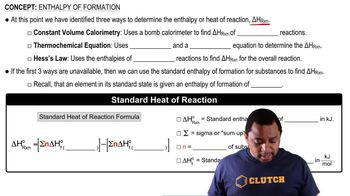
Standard Enthalpy of Formation (H°f)

The standard enthalpy of formation (H°f) is the change in enthalpy when one mole of a compound is formed from its elements in their standard states. It is a key concept in thermodynamics and is used to calculate the enthalpy changes in reactions. To find H°f for CaC2(s), one must apply Hess's law, which states that the total enthalpy change for a reaction is the sum of the enthalpy changes for individual steps.
추천 영상:
가이드 코스
02:34
Enthalpy of Formation

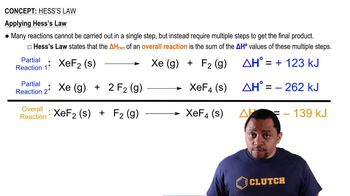
Hess's Law

Hess's Law states that the total enthalpy change for a chemical reaction is the same, regardless of the number of steps or the pathway taken. This principle allows chemists to calculate the enthalpy change of a reaction indirectly by using known enthalpy changes of other reactions. In this case, it can be applied to derive the standard enthalpy of formation for CaC2(s) by combining the enthalpy of the given reaction with the enthalpies of formation of the products and reactants.
추천 영상:
관련 실천
교과서 질문

Using values from Appendix C, calculate the value of H for each of the following reactions: (a) CaO(s) + 2 HF(g) → CaF2(s) + H2O(g) (b) Fe2O3(s) + 3 C(s) → 2 Fe(s) + 3CO(g) (c) 2 CO(g) + 2 NO(g) → N2(s) + 2 CO2(g) (d) 4 NH3(g) + 5 O2(g) → 4 NO(g) + 6 H2Og)

1078
views
교과서 질문

Ethanol (C2H5OH) is blended with gasoline as an automobile fuel. (b) Calculate the standard enthalpy change for the reaction, assuming H2O(g) as a product.

교과서 질문

Gasoline is composed primarily of hydrocarbons, including many with eight carbon atoms, called octanes. One of the cleanest–burning octanes is a compound called 2,3,4- trimethylpentane, which has the following structural formula: The complete combustion of one mole of this compound to CO2(g) and H2O(g) leads to ΔH° = -5064.9 kJ. (b) By using the information in this problem and data in Table 5.3, calculate H°f for 2,3,4-trimethylpentane.

1204
views
교과서 질문

Complete combustion of 1 mol of acetone (C3H6O) liberates 1790 kJ: C3H6O(l) + 4 O2(g) → 3 CO2(g) + 3 H2O(l) ΔH° = -1790 kJ Using this information together with the standard enthalpies of formation of O2(g), CO2(g), and H2O(l) from Appendix C, calculate the standard enthalpy of formation of acetone.

2665
views
교과서 질문

Diethyl ether, C4H10O(l), a flammable compound that was once used as a surgical anesthetic, has the structure The complete combustion of 1 mol of C4H10O(l) to CO2(g) and H2O(l) yields ΔH° = -2723.7 kJ. (a) Write a balanced equation for the combustion of 1 mol of C4H10O(l).

911
views