Ch.5 - Thermochemistry
Brown - Chemistry: The Central Science 14th Edition
Brown14th EditionChemistry: The Central ScienceISBN: 9780134414232당신이 사용하는 게 아니라요?교과서 변경
5장, 문제 25b

Calculate ΔE and determine whether the process is endothermic or exothermic for the following cases: (b) A system releases 66.1 kJ of heat to its surroundings while the surroundings do 44.0 kJ of work on the system.

검증된 단계별 안내
1
Understand the concept of energy change (ΔE) in a system, which is given by the formula: ΔE = q + w, where q is the heat exchanged and w is the work done.
Identify the values given in the problem: the system releases 66.1 kJ of heat, so q = -66.1 kJ (negative because heat is released), and the surroundings do 44.0 kJ of work on the system, so w = 44.0 kJ (positive because work is done on the system).
Substitute the values into the formula: ΔE = q + w = (-66.1 kJ) + (44.0 kJ).
Calculate the value of ΔE using the substituted values. This will give you the total energy change of the system.
Determine whether the process is endothermic or exothermic: if ΔE is positive, the process is endothermic (energy is absorbed by the system); if ΔE is negative, the process is exothermic (energy is released by the system).

비슷한 문제에 대한 검증된 영상 답변:

이 영상 해법은 위 문제에 도움이 된다고 튜터들이 추천한 것입니다.
영상 길이:
3m
도움이 되었나요?

주요 개념

질문에 올바르게 답하기 위해 반드시 이해해야 하는 핵심 개념들은 다음과 같습니다.

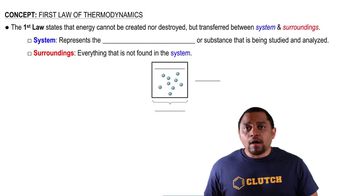
First Law of Thermodynamics

The First Law of Thermodynamics states that energy cannot be created or destroyed, only transformed from one form to another. In a closed system, the change in internal energy (ΔE) is equal to the heat added to the system minus the work done by the system. This principle is fundamental for analyzing energy changes in thermodynamic processes.
추천 영상:
가이드 코스
01:18
First Law of Thermodynamics

Endothermic and Exothermic Processes

Endothermic processes absorb heat from the surroundings, resulting in a positive ΔE, while exothermic processes release heat, leading to a negative ΔE. Understanding whether a process is endothermic or exothermic is crucial for predicting the direction of energy flow and the system's behavior in response to heat and work interactions.
추천 영상:
가이드 코스
1:48
Endothermic & Exothermic Reactions Example 2

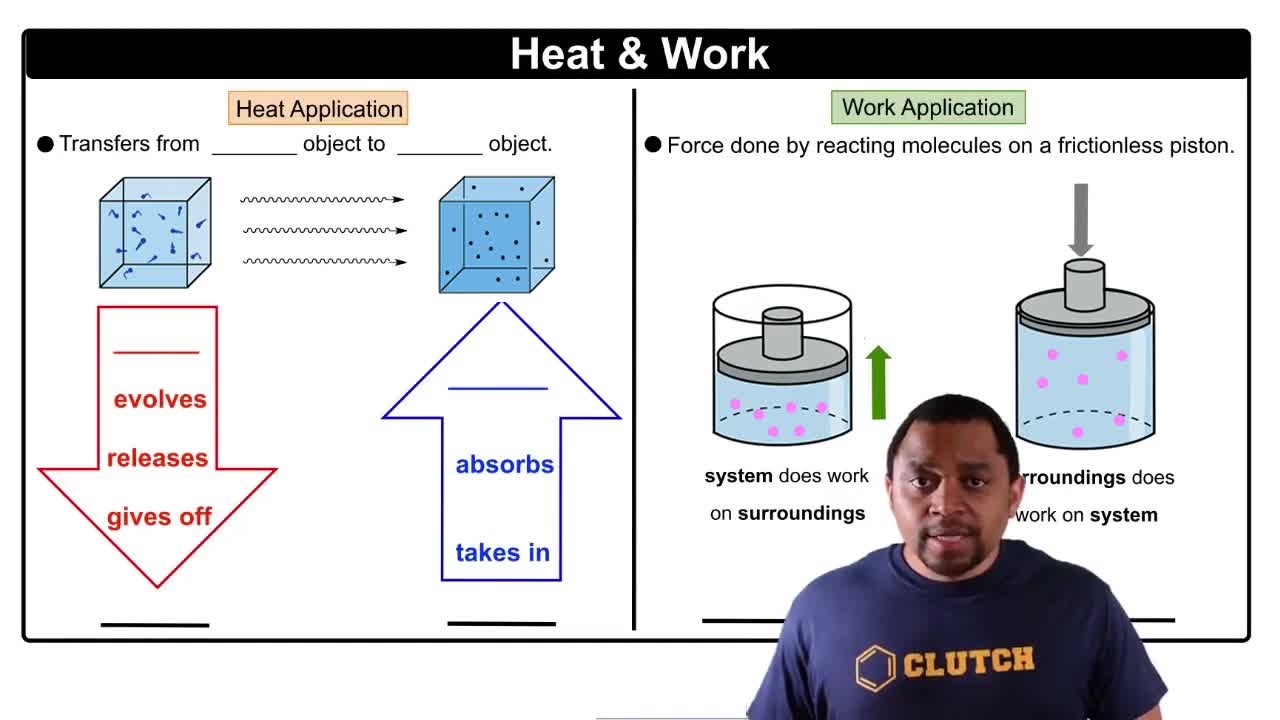
Work and Heat in Thermodynamics

In thermodynamics, work and heat are two ways energy can be transferred between a system and its surroundings. Work is done on or by the system, while heat refers to energy transfer due to temperature differences. The signs of heat and work are essential for calculating ΔE and determining the nature of the process (endothermic or exothermic).
추천 영상:
가이드 코스
02:50
First Law of Thermodynamics
관련 실천
교과서 질문

(c) By what means can the internal energy of a closed system increase?

606
views

교과서 질문

A gas is confined to a cylinder fitted with a piston and an electrical heater, as shown here:

Suppose that current is supplied to the heater so that 100 J of energy is added. Consider two different situations. In case (1) the piston is allowed to move as the energy is added. In case (2) the piston is fixed so that it cannot move. (b) Identify the sign (positive, negative, or zero) of q and w in each case?

511
views
교과서 질문

Calculate ΔE and determine whether the process is endothermic or exothermic for the following cases: (a) q = 0.763 kJ and w = -840 J.

1056
views
교과서 질문

A gas is confined to a cylinder fitted with a piston and an electrical heater, as shown here:

Suppose that current is supplied to the heater so that 100 J of energy is added. Consider two different situations. In case (1) the piston is allowed to move as the energy is added. In case (2) the piston is fixed so that it cannot move. (a) In which case does the gas have the higher temperature after addition of the electrical energy?

753
views
교과서 질문

For the following processes, calculate the change in internal energy of the system and determine whether the process is endothermic or exothermic: (a) A balloon is cooled by removing 0.655 kJ of heat. It shrinks on cooling, and the atmosphere does 382 J of work on the balloon. (b) A 100.0-g bar of gold is heated from 25 °C to 50 °C during which it absorbs 322 J of heat. Assume the volume of the gold bar remains constant.

973
views