Ch.5 - Thermochemistry
Brown - Chemistry: The Central Science 14th Edition
Brown14th EditionChemistry: The Central ScienceISBN: 9780134414232당신이 사용하는 게 아니라요?교과서 변경
5장, 문제 22a

In a thermodynamic study, a scientist focuses on the properties of a solution in an apparatus as illustrated. A solution is continuously flowing into the apparatus at the top and out at the bottom, such that the amount of solution in the apparatus is constant with time. (a) Is the solution in the apparatus a closed system, open system, or isolated system?
Diagram of an apparatus showing solution flow with inlet and outlet for thermodynamic study.

검증된 단계별 안내
1
Step 1: Understand the definitions of different types of systems in thermodynamics. A closed system can exchange energy but not matter with its surroundings. An open system can exchange both energy and matter with its surroundings. An isolated system cannot exchange either energy or matter with its surroundings.
Step 2: Analyze the diagram provided. Notice that there is an inlet and an outlet for the solution, indicating that matter is flowing into and out of the apparatus.
Step 3: Determine if energy exchange is possible. Since the solution is flowing, it implies that energy in the form of heat or work could also be exchanged with the surroundings.
Step 4: Based on the definitions and the observations from the diagram, conclude that the system is an open system because it allows the exchange of both matter and energy with its surroundings.
Step 5: Summarize the conclusion: The solution in the apparatus is an open system.

비슷한 문제에 대한 검증된 영상 답변:

이 영상 해법은 위 문제에 도움이 된다고 튜터들이 추천한 것입니다.
영상 길이:
2m
도움이 되었나요?

주요 개념

질문에 올바르게 답하기 위해 반드시 이해해야 하는 핵심 개념들은 다음과 같습니다.

Thermodynamic Systems

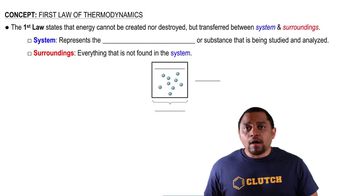
Thermodynamic systems are classified into three types: open, closed, and isolated. An open system can exchange both matter and energy with its surroundings, while a closed system can exchange energy but not matter. An isolated system does not exchange either matter or energy. Understanding these classifications is crucial for analyzing the behavior of substances in thermodynamic studies.
추천 영상:
가이드 코스
01:18
First Law of Thermodynamics

Flow Dynamics

In the context of the apparatus described, flow dynamics refers to the continuous movement of the solution into and out of the system. This flow indicates that the system is not static, and the properties of the solution can change over time. Recognizing how flow affects concentration, temperature, and pressure is essential for understanding the thermodynamic properties of the solution.
추천 영상:
가이드 코스
01:18
Chemical Equilibrium Example

System Equilibrium

System equilibrium occurs when the properties of a system remain constant over time, despite ongoing processes. In the given scenario, the constant inflow and outflow of the solution suggest that the system may reach a dynamic equilibrium where the concentrations of solutes remain stable. This concept is vital for predicting how the system will behave under continuous flow conditions.
추천 영상:
가이드 코스
02:35
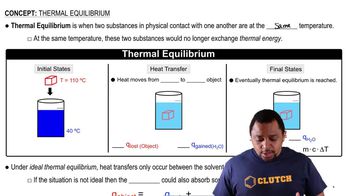
Thermal Equilibrium