
The decomposition of sodium bicarbonate (baking soda), NaHCO3(s), into Na2CO3(s), H2O(l), and CO2(g) at constant pressure requires the addition of 85 kJ of heat per two moles of NaHCO3. (a) Write a balanced thermochemical equation for the reaction.
Ch.5 - Thermochemistry
5장, 문제 39a
The complete combustion of methane, CH4(g), to form H2O(l) and CO2(g) at constant pressure releases 890 kJ of heat per mole of CH4. (a) Write a balanced thermochemical equation for this reaction.
검증된 단계별 안내1
Identify the reactants and products in the combustion of methane. Methane (CH4) reacts with oxygen (O2) to produce carbon dioxide (CO2) and water (H2O).
Write the unbalanced chemical equation for the combustion of methane: CH4(g) + O2(g) -> CO2(g) + H2O(l).
Balance the chemical equation. Start by balancing the carbon atoms: CH4(g) + O2(g) -> CO2(g) + H2O(l). Since there is one carbon atom in CH4 and one in CO2, the carbon is already balanced.
Next, balance the hydrogen atoms. There are 4 hydrogen atoms in CH4, so you need 2 H2O molecules to balance the hydrogen: CH4(g) + O2(g) -> CO2(g) + 2 H2O(l).
Finally, balance the oxygen atoms. There are 2 oxygen atoms in CO2 and 2 in 2 H2O, totaling 4 oxygen atoms needed. Therefore, you need 2 O2 molecules: CH4(g) + 2 O2(g) -> CO2(g) + 2 H2O(l). Include the enthalpy change: CH4(g) + 2 O2(g) -> CO2(g) + 2 H2O(l) ΔH = -890 kJ/mol.

비슷한 문제에 대한 검증된 영상 답변:
이 영상 해법은 위 문제에 도움이 된다고 튜터들이 추천한 것입니다.
영상 길이:
4m도움이 되었나요?
주요 개념
질문에 올바르게 답하기 위해 반드시 이해해야 하는 핵심 개념들은 다음과 같습니다.
Balanced Chemical Equation
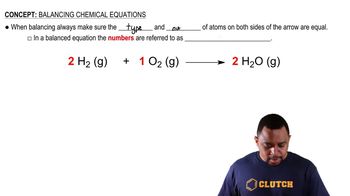
A balanced chemical equation represents a chemical reaction with equal numbers of each type of atom on both sides of the equation. This ensures the law of conservation of mass is upheld, meaning that matter is neither created nor destroyed in the reaction. For combustion reactions, it is essential to balance the reactants and products, including the correct stoichiometric coefficients for all species involved.
추천 영상:
가이드 코스
Balancing Chemical Equations
Thermochemical Equation
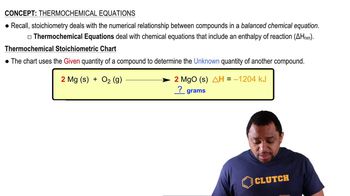
A thermochemical equation includes not only the balanced chemical equation but also the heat change associated with the reaction. It indicates whether the reaction is exothermic (releases heat) or endothermic (absorbs heat). In this case, the combustion of methane is exothermic, releasing 890 kJ of heat per mole of CH4, which should be included in the equation.
추천 영상:
가이드 코스
Thermochemical Equations
Combustion Reaction
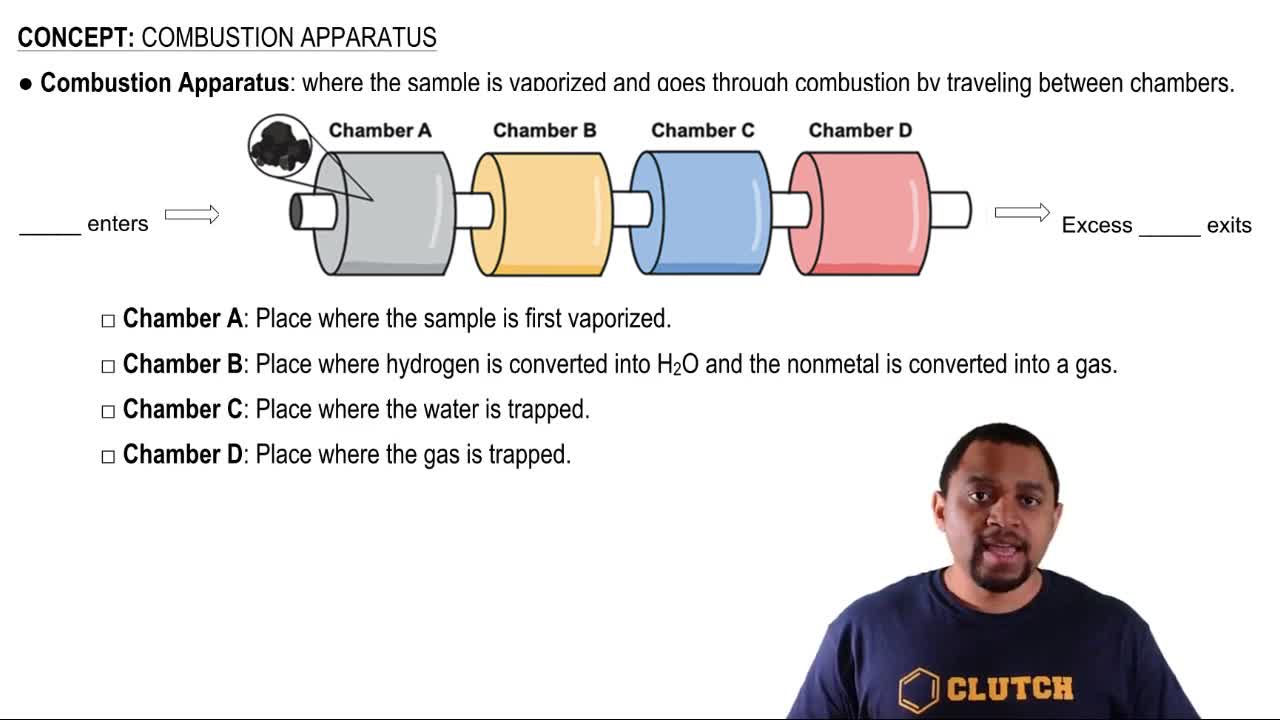
A combustion reaction is a type of chemical reaction where a substance (usually a hydrocarbon) reacts with oxygen to produce carbon dioxide and water, releasing energy in the form of heat and light. In the case of methane, the complete combustion involves the reaction of CH4 with O2 to yield CO2 and H2O, making it a key example of an exothermic reaction in organic chemistry.
추천 영상:
가이드 코스
Combustion Apparatus
관련 실천
교과서 질문
교과서 질문
The complete combustion of methane, CH4(g), to form H2O(l) and CO2(g) at constant pressure releases 890 kJ of heat per mole of CH4. (b) Draw an enthalpy diagram for the reaction.
880
views
교과서 질문
A gas is confined to a cylinder under constant atmospheric pressure, as illustrated in Figure 5.4. When 0.49 kJ of heat is added to the gas, it expands and does 214 J of work on the surroundings. What are the values of H and E for this process?
3137
views
교과서 질문
Atomic hydrogen (H) is used in welding (AHW). The atoms recombine to hydrogen molecules with a large release of heat according to the following reaction: 2 H(g) → H2(g) (a) Using the thermodynamic data in Appendix C, calculate the enthalpy change for this reaction per mole of H2.
