Ch.5 - Thermochemistry
Brown - Chemistry: The Central Science 14th Edition
Brown14th EditionChemistry: The Central ScienceISBN: 9780134414232당신이 사용하는 게 아니라요?교과서 변경
5장, 문제 6

Under constant-volume conditions, the heat of combustion of naphthalene (C10H8) is 40.18 kJ/g. A 2.50-g sample of naphthalene is burned in a bomb calorimeter. The temperature of the calorimeter increases from 21.50 to 28.83 °C. (b) A 1.50-g sample of a new organic substance is combusted in the same calorimeter. The temperature of the calorimeter increases from 21.14 to 25.08 °C. What is the heat of combustion per gram of the new substance?

검증된 단계별 안내
1
Step 1: Understand the concept of heat of combustion. It is the amount of heat released when a substance is burned completely in oxygen under constant volume conditions. In this problem, we are dealing with a bomb calorimeter, which measures the heat of combustion.
Step 2: Calculate the total heat released by the naphthalene sample using its heat of combustion. Use the formula: \( q = m \times \Delta H_{combustion} \), where \( q \) is the heat released, \( m \) is the mass of the sample, and \( \Delta H_{combustion} \) is the heat of combustion per gram.
Step 3: Determine the heat capacity of the calorimeter. The heat released by the naphthalene sample causes a temperature change in the calorimeter. Use the formula: \( q = C_{cal} \times \Delta T \), where \( C_{cal} \) is the heat capacity of the calorimeter and \( \Delta T \) is the change in temperature.
Step 4: Calculate the heat released by the new organic substance using the same calorimeter. Use the formula: \( q = C_{cal} \times \Delta T \), where \( \Delta T \) is the temperature change caused by the combustion of the new substance.
Step 5: Determine the heat of combustion per gram of the new substance. Use the formula: \( \Delta H_{combustion} = \frac{q}{m} \), where \( q \) is the heat released and \( m \) is the mass of the new substance.

주요 개념

질문에 올바르게 답하기 위해 반드시 이해해야 하는 핵심 개념들은 다음과 같습니다.

Heat of Combustion

The heat of combustion is the amount of energy released when a substance undergoes complete combustion with oxygen. It is typically expressed in kilojoules per gram (kJ/g) and is a crucial parameter in thermochemistry, as it helps quantify the energy content of fuels. Understanding this concept is essential for calculating the energy released during the combustion of different substances.
추천 영상:
가이드 코스
02:24
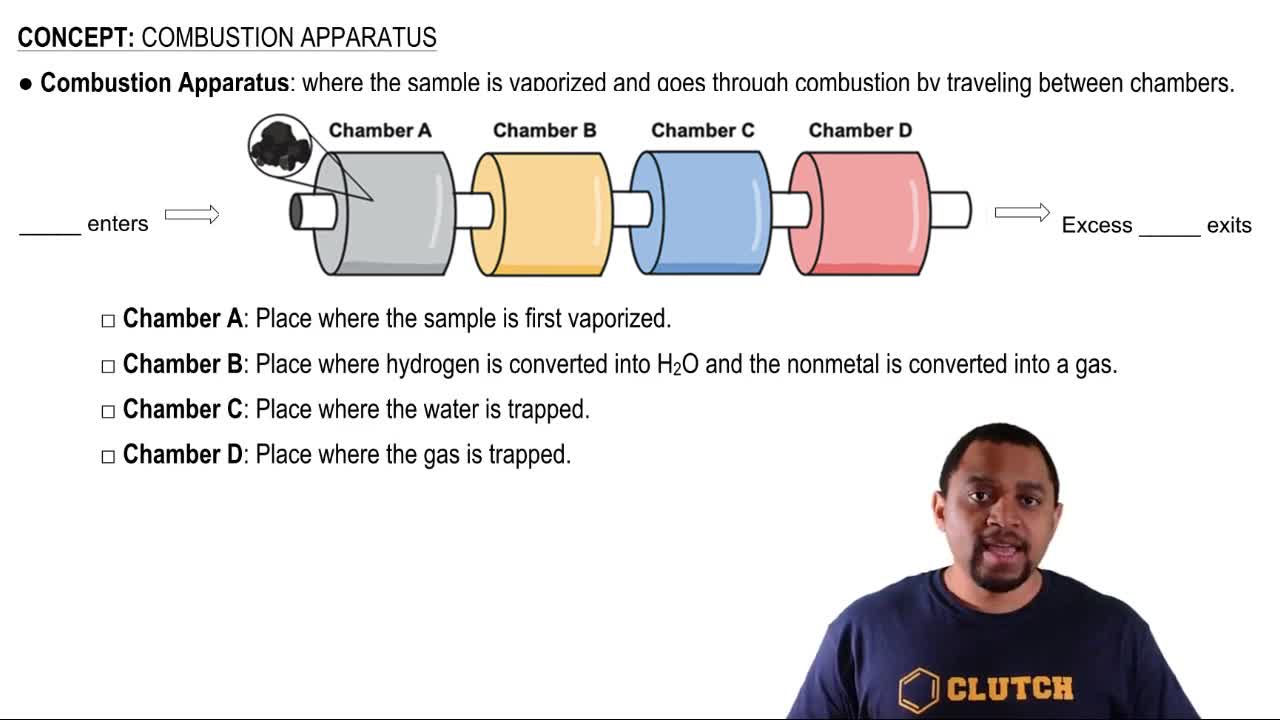
Combustion Apparatus

Calorimetry

Calorimetry is the science of measuring the heat of chemical reactions or physical changes. In a bomb calorimeter, the heat released from a combustion reaction is absorbed by the surrounding water, leading to a temperature change that can be measured. This temperature change is used to calculate the heat of combustion, making calorimetry a vital tool in thermodynamic studies.
추천 영상:
가이드 코스
00:50
Constant-Volume Calorimetry

Temperature Change and Specific Heat Capacity

The temperature change in a calorimeter is directly related to the amount of heat absorbed by the water, which can be calculated using the formula q = mcΔT, where q is the heat absorbed, m is the mass of the water, c is the specific heat capacity, and ΔT is the change in temperature. This relationship is fundamental for determining the heat of combustion of a substance based on the observed temperature change in the calorimeter.
추천 영상: