Ch.5 - Thermochemistry
Brown - Chemistry: The Central Science 14th Edition
Brown14th EditionChemistry: The Central ScienceISBN: 9780134414232당신이 사용하는 게 아니라요?교과서 변경
5장, 문제 42c,d

Without referring to tables, predict which of the following has the higher enthalpy in each case: (c) 1 mol I2(g) and 1 mol H2(g) at 25 °C or 2 mol HI(g) at 25 °C (d) 1 mol H2(g) at 100 °C or 1 mol H2(g) at 300 °C.

검증된 단계별 안내
1
Identify the chemical reaction involved: I_2(g) + H_2(g) -> 2 HI(g).
Understand that enthalpy is a measure of the total energy of a thermodynamic system, often associated with the heat content.
Recognize that the formation of bonds releases energy (exothermic), while breaking bonds requires energy (endothermic).
Consider the bond energies: breaking the I-I and H-H bonds requires energy, while forming two H-I bonds releases energy.
Predict that the enthalpy of the products (2 mol HI) is lower than the enthalpy of the reactants (1 mol I_2 and 1 mol H_2) because the formation of HI releases more energy than is required to break the I_2 and H_2 bonds.

비슷한 문제에 대한 검증된 영상 답변:

이 영상 해법은 위 문제에 도움이 된다고 튜터들이 추천한 것입니다.
영상 길이:
1m
도움이 되었나요?

주요 개념

질문에 올바르게 답하기 위해 반드시 이해해야 하는 핵심 개념들은 다음과 같습니다.

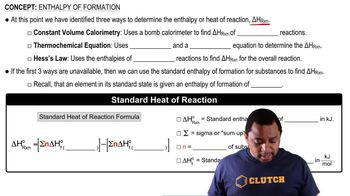
Enthalpy of Formation

Enthalpy of formation refers to the change in enthalpy when one mole of a compound is formed from its elements in their standard states. It is a crucial concept in thermodynamics, as it helps predict the stability and energy content of compounds. For example, the formation of hydrogen iodide (HI) from hydrogen (H2) and iodine (I2) involves specific enthalpy changes that can be compared to the enthalpy of the reactants.
추천 영상:
가이드 코스
02:34
Enthalpy of Formation

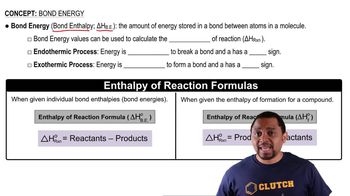
Bond Energies

Bond energies represent the amount of energy required to break a bond between two atoms in a molecule. The strength of these bonds directly influences the enthalpy of a substance; stronger bonds typically correlate with lower enthalpy. In the case of HI, the bond energy between H and I will affect the overall enthalpy when comparing it to the elemental gases I2 and H2.
추천 영상:

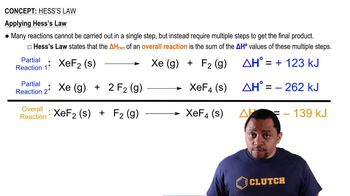
Hess's Law

Hess's Law states that the total enthalpy change for a chemical reaction is the same, regardless of the number of steps taken to achieve the reaction. This principle allows for the calculation of enthalpy changes by summing the enthalpy changes of individual steps. In this question, Hess's Law can be applied to compare the enthalpy of the reactants (I2 and H2) with the product (HI) to determine which has a higher enthalpy.
추천 영상: