
Ch.6 - Electronic Structure of Atoms
Brown - Chemistry: The Central Science 14th Edition
Brown14th EditionChemistry: The Central ScienceISBN: 9780134414232당신이 사용하는 게 아니라요?교과서 변경
6장, 문제 55a

(a) For n = 4, what are the possible values of l?

검증된 단계별 안내
1
insert step 1> Identify the principal quantum number (n) given in the problem, which is n = 4.
insert step 2> Recall that the azimuthal quantum number (l) can take integer values from 0 to n-1.
insert step 3> Calculate the possible values of l by substituting n = 4 into the range 0 to n-1, which gives 0, 1, 2, and 3.
insert step 4> Understand that each value of l corresponds to a different type of orbital: l = 0 (s orbital), l = 1 (p orbital), l = 2 (d orbital), and l = 3 (f orbital).
insert step 5> Conclude that for n = 4, the possible values of l are 0, 1, 2, and 3, representing the s, p, d, and f orbitals respectively.

비슷한 문제에 대한 검증된 영상 답변:

이 영상 해법은 위 문제에 도움이 된다고 튜터들이 추천한 것입니다.
영상 길이:
55s
도움이 되었나요?

주요 개념

질문에 올바르게 답하기 위해 반드시 이해해야 하는 핵심 개념들은 다음과 같습니다.

Quantum Numbers

Quantum numbers are a set of numerical values that describe the unique quantum state of an electron in an atom. They include the principal quantum number (n), azimuthal quantum number (l), magnetic quantum number (m_l), and spin quantum number (m_s). Each quantum number provides specific information about the electron's energy level, shape, orientation, and spin.
추천 영상:
가이드 코스
02:55
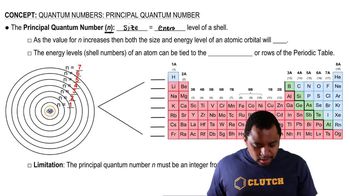
Principal Quantum Number

Principal Quantum Number (n)

The principal quantum number (n) indicates the main energy level or shell of an electron in an atom. It can take positive integer values (1, 2, 3, ...), with higher values corresponding to electrons that are further from the nucleus and have higher energy. In this case, n = 4 signifies the fourth energy level.
추천 영상:
가이드 코스
02:55
Principal Quantum Number

Azimuthal Quantum Number (l)

The azimuthal quantum number (l) defines the shape of the electron's orbital and can take on integer values from 0 to (n-1). For n = 4, the possible values of l are 0, 1, 2, and 3, which correspond to the s, p, d, and f orbitals, respectively. This concept is crucial for understanding the distribution of electrons in an atom.
추천 영상:
가이드 코스
03:06
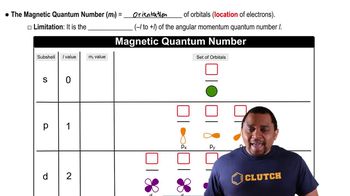
Magnetic Quantum Number