
Ch.6 - Electronic Structure of Atoms
Brown - Chemistry: The Central Science 14th Edition
Brown14th EditionChemistry: The Central ScienceISBN: 9780134414232당신이 사용하는 게 아니라요?교과서 변경
6장, 문제 70c

An experiment called the Stern–Gerlach experiment helped establish the existence of electron spin. In this experiment, a beam of silver atoms is passed through a magnetic field, which deflects half of the silver atoms in one direction and half in the opposite direction. The separation between the two beams increases as the strength of the magnetic field increases. (c) Would this experiment work for a beam of fluorine (F) atoms?

검증된 단계별 안내
1
Understand the electron configuration of fluorine atoms. Fluorine has 9 electrons with the electron configuration of 1s² 2s² 2p⁵. This results in a single unpaired electron in the 2p orbital.
Recall that the Stern-Gerlach experiment is based on the principle that particles with a magnetic moment (due to unpaired electrons) will be deflected by a magnetic field. The direction of deflection depends on the orientation of the magnetic moment relative to the magnetic field.
Consider the presence of the unpaired electron in fluorine. This unpaired electron gives fluorine a magnetic moment, which is a crucial factor for the Stern-Gerlach experiment.
Analyze the effect of the magnetic field on fluorine atoms. Since fluorine has an unpaired electron, it should experience a force when subjected to a magnetic field, similar to the silver atoms in the original experiment.
Conclude whether the Stern-Gerlach experiment would work for fluorine atoms. Given that fluorine has an unpaired electron and thus a magnetic moment, it should be possible to observe a deflection of fluorine atoms in a magnetic field, similar to that observed with silver atoms.

비슷한 문제에 대한 검증된 영상 답변:

이 영상 해법은 위 문제에 도움이 된다고 튜터들이 추천한 것입니다.
영상 길이:
4m
도움이 되었나요?

주요 개념

질문에 올바르게 답하기 위해 반드시 이해해야 하는 핵심 개념들은 다음과 같습니다.

Electron Spin

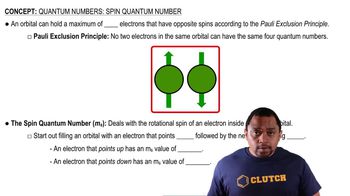
Electron spin is a fundamental property of electrons, akin to angular momentum, that describes their intrinsic magnetic moment. It can take on one of two values, often referred to as 'spin-up' and 'spin-down'. This property is crucial for understanding how electrons behave in magnetic fields and is a key factor in quantum mechanics.
추천 영상:
가이드 코스
01:18
Spin Quantum Number

Magnetic Field Interaction

When charged particles, such as electrons, move through a magnetic field, they experience a force that can alter their trajectory. The Stern–Gerlach experiment demonstrates this interaction by showing how particles with different spin states are deflected in opposite directions, leading to the quantization of angular momentum in quantum systems.
추천 영상:
가이드 코스
01:18
The study of ligand-metal interactions helped to form Ligand Field Theory which combines CFT with MO Theory.

Atomic Structure of Fluorine

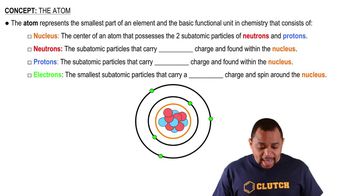
Fluorine (F) is a diatomic molecule with a specific electron configuration that influences its magnetic properties. Unlike silver, which has unpaired electrons contributing to its magnetic moment, fluorine has a filled outer shell, resulting in paired electrons that cancel out their magnetic effects. This difference is critical in determining whether the Stern–Gerlach experiment would yield observable results with fluorine atoms.
추천 영상: