
Ch.6 - Electronic Structure of Atoms
Brown - Chemistry: The Central Science 14th Edition
Brown14th EditionChemistry: The Central ScienceISBN: 9780134414232당신이 사용하는 게 아니라요?교과서 변경
6장, 문제 83c

Certain elements emit light of a specific wavelength when they are burned or heated in a non-luminous flame. Historically, chemists used such emission wavelengths to determine whether specific elements were present in a sample. Some characteristic wavelengths for a few of the elements are given in the following table: Ag 328.1 nm Fe 372.0 nm Au 267.6 nm K 404.7 nm Ba 455.4 nm Mg 285.2 nm Ca 422.7 nm Na 589.6 nm Cu 324.8 nm Ni 341.5 nm (c) When burned, a sample of an unknown substance is found to emit light of frequency 6.58 × 10¹⁴ s-1. Which of these elements is probably in the sample?

검증된 단계별 안내
1
1. The problem provides the frequency of the light emitted by the unknown substance. However, the table provides the wavelengths of the light emitted by known substances. To compare these values, we need to convert the given frequency to wavelength. We can do this using the formula for the speed of light, which is \(c = \lambda \nu\), where \(c\) is the speed of light, \(\lambda\) is the wavelength, and \(\nu\) is the frequency.
2. Rearrange the formula to solve for wavelength: \(\lambda = \frac{c}{\nu}\).
3. Substitute the given frequency and the speed of light (approximately \(3.00 \times 10^8\) m/s) into the formula to calculate the wavelength. Remember to convert the wavelength from meters to nanometers by multiplying by \(1 \times 10^9\).
4. Once you have the wavelength of the light emitted by the unknown substance, compare this value to the wavelengths given in the table.
5. The element in the table with a wavelength closest to the calculated wavelength is likely the element present in the unknown substance.

비슷한 문제에 대한 검증된 영상 답변:

이 영상 해법은 위 문제에 도움이 된다고 튜터들이 추천한 것입니다.
영상 길이:
3m
도움이 되었나요?

주요 개념

질문에 올바르게 답하기 위해 반드시 이해해야 하는 핵심 개념들은 다음과 같습니다.

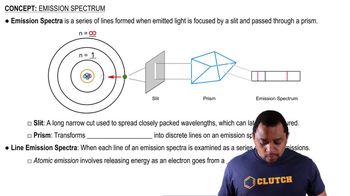
Emission Spectra

Emission spectra are unique patterns of light emitted by elements when they are heated or energized. Each element emits light at specific wavelengths, which correspond to the energy transitions of electrons within the atoms. By analyzing these wavelengths, chemists can identify the presence of particular elements in a sample.
추천 영상:
가이드 코스
01:51
Emission Spectra

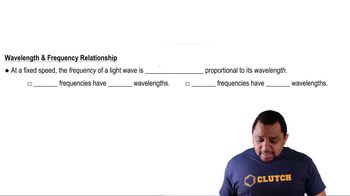
Wavelength and Frequency Relationship

The relationship between wavelength and frequency is described by the equation c = λν, where c is the speed of light, λ is the wavelength, and ν is the frequency. This means that as the frequency of light increases, its wavelength decreases, and vice versa. Understanding this relationship is crucial for converting the given frequency of light emitted by the unknown substance into a wavelength for comparison with known emission wavelengths.
추천 영상:
가이드 코스
00:31
Frequency-Wavelength Relationship

Quantization of Energy Levels

In atoms, electrons occupy quantized energy levels, and transitions between these levels result in the emission or absorption of light at specific wavelengths. When an electron moves from a higher energy level to a lower one, it emits a photon with energy equal to the difference between the two levels. This principle underlies the characteristic wavelengths observed in the emission spectra of elements.
추천 영상:
가이드 코스
01:26
Nature of Energy
관련 실천
교과서 질문

If a sample of calcium chloride is introduced into a nonluminous flame, the color of the flame turns to orange (“flame test”). The light is emitted because calcium atoms become excited; their return to the ground state results in light emission. (c) Calculate the energy gap between the excited and ground states for the calcium atom.

교과서 질문

In January 2006, the New Horizons space probe was launched from Earth with the mission to perform a flyby study of Pluto. The arrival at the dwarf planet was estimated to happen after nine years, in 2015. The distance between Earth and Pluto varies depending on the location of the planets in their orbits, but at their closest, the distance is 4.2 billion kilometers (2.6 billion miles). Calculate the minimum amount of time it takes for a transmitted signal from Pluto to reach the Earth.

600
views
교과서 질문

The watt is the derived SI unit of power, the measure of energy per unit time: 1 W = 1 J>s. A semiconductor laser in a DVD player has an output wavelength of 650 nm and a power level of 5.0 mW. How many photons strike the DVD surface during the playing of a DVD 90 minutes in length?

2645
views
교과서 질문

Certain elements emit light of a specific wavelength when they are burned or heated in a non-luminous flame. Historically, chemists used such emission wavelengths to determine whether specific elements were present in a sample. Some characteristic wavelengths for a few of the elements are given in the following table: Ag 328.1 nm Fe 372.0 nm Au 267.6 nm K 404.7 nm Ba 455.4 nm Mg 285.2 nm Ca 422.7 nm Na 589.6 nm Cu 324.8 nm Ni 341.5 nm (a) Determine which of these emissions occur in the ultraviolet part of the spectrum.

교과서 질문

If a sample of calcium chloride is introduced into a nonluminous flame, the color of the flame turns to orange ('flame test'). The light is emitted because calcium atoms become excited; their return to the ground state results in light emission. (b) What is the energy of 1.00 mol of these photons (a mole of photons is called an Einstein)?

3001
views