Is energy emitted or absorbed when the following electronic transitions occur in hydrogen? (a) from n = 3 to n = 2 (c) an electron adds to the H+ ion and ends up in the n = 2 shell?
Ch.6 - Electronic Structure of Atoms
6장, 문제 36
Classify each of the following statements as either true or false: (a) A hydrogen atom in the n = 3 state can emit light at only two specific wavelengths (b) a hydrogen atom in the n = 2 state is at a lower energy than one in the n = 1 state (c) the energy of an emitted photon equals the energy difference of the two states involved in the emission.
검증된 단계별 안내1
Identify the concept of energy states in a hydrogen atom. The principal quantum number, n, indicates the energy level of an electron in a hydrogen atom. Higher values of n correspond to higher energy levels.
Understand the process of emission in hydrogen atoms. When an electron transitions from a higher energy state to a lower energy state, it emits a photon whose energy is equal to the difference in energy between these two states.
Analyze statement (a): Consider all possible transitions for a hydrogen atom in the n = 3 state. Determine if the electron can only transition to two specific lower energy states or if there are more possible transitions that would result in the emission of photons at different wavelengths.
Evaluate statement (b): Compare the energy levels of a hydrogen atom in the n = 2 state and the n = 1 state. Recall that lower values of n correspond to lower energy levels, thus determining the relative energies of these states.
Assess statement (c): Apply the concept that the energy of a photon emitted during a transition is equal to the difference in energy between the initial and final states. Verify if this statement is universally true for all transitions in a hydrogen atom.

비슷한 문제에 대한 검증된 영상 답변:
이 영상 해법은 위 문제에 도움이 된다고 튜터들이 추천한 것입니다.
영상 길이:
1m도움이 되었나요?
주요 개념
질문에 올바르게 답하기 위해 반드시 이해해야 하는 핵심 개념들은 다음과 같습니다.
Energy Levels in Hydrogen Atom
In a hydrogen atom, electrons occupy discrete energy levels, denoted by quantum numbers (n). The energy of these levels increases with n, meaning that an electron in a higher state (like n=3) has more energy than one in a lower state (like n=1). This concept is fundamental to understanding electron transitions and the emission of light.
추천 영상:
가이드 코스
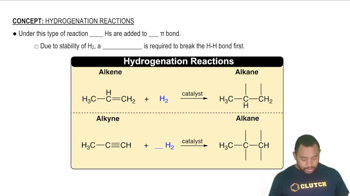
Hydrogenation Reactions
Photon Emission and Wavelengths
When an electron transitions between energy levels in a hydrogen atom, it can emit a photon with a specific wavelength. The emitted wavelength corresponds to the energy difference between the two levels involved in the transition. Therefore, a hydrogen atom in a given state can emit light at specific wavelengths determined by these energy differences.
추천 영상:
가이드 코스
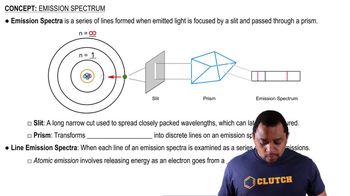
Emission Spectra
Energy of Emitted Photons
The energy of an emitted photon is directly related to the difference in energy between the two electron states involved in the transition. This relationship is described by the equation E = hν, where E is the energy of the photon, h is Planck's constant, and ν is the frequency of the emitted light. This principle is crucial for understanding how light is produced in atomic transitions.
추천 영상:
가이드 코스
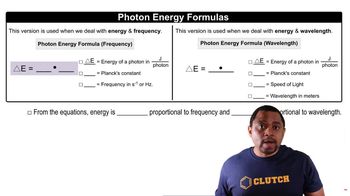
Photon Energy Formulas
관련 실천
교과서 질문
734
views
교과서 질문
Does the hydrogen atom 'expand' or 'contract' when an electron is excited from the n = 1 state to the n = 3 state?
1095
views
교과서 질문
Indicate whether energy is emitted or absorbed when the following electronic transitions occur in hydrogen: (a) from n = 2 to n = 3 (c) from the n = 9 to the n = 6 state.
752
views
교과서 질문
Molybdenum metal must absorb radiation with an energy higher than 7.22 * 10-19 J ('energy threshold') before it can eject an electron from its surface via the photoelectric effect. (c) If molybdenum is irradiated with light of wavelength of 240 nm, what is the maximum possible velocity of the emitted electrons?
637
views
1
comments
교과서 질문
Is energy emitted or absorbed when the following electronic transitions occur in hydrogen? (b) from an orbit of radius 0.846 nm to one of radius 0.212 nm
1575
views