

Ch.6 - Electronic Structure of Atoms
Brown - Chemistry: The Central Science 14th Edition
Brown14th EditionChemistry: The Central ScienceISBN: 9780134414232당신이 사용하는 게 아니라요?교과서 변경
6장, 문제 89c

Consider a transition in which the electron of a hydrogen atom is excited from n = 1 to n = ∞.  (c) What will occur if light with a shorter wavelength than that in part (b) is used to excite the hydrogen atom?

검증된 단계별 안내
1
Understand the concept of electron transitions in a hydrogen atom: When an electron in a hydrogen atom absorbs energy, it can move from a lower energy level (n = 1) to a higher energy level (n = ∞). This is known as an excitation process.
Recall that the energy of a photon is inversely proportional to its wavelength, as described by the equation: \( E = \frac{hc}{\lambda} \), where \( E \) is the energy, \( h \) is Planck's constant, \( c \) is the speed of light, and \( \lambda \) is the wavelength.
If light with a shorter wavelength than that used in part (b) is used, it means the light has higher energy because shorter wavelengths correspond to higher energy photons.
Consider the implications of using higher energy photons: If the energy of the incoming photon is greater than the energy required to excite the electron from n = 1 to n = ∞, the excess energy can ionize the hydrogen atom, completely removing the electron from the atom.
Conclude that using light with a shorter wavelength (higher energy) than necessary for the transition to n = ∞ can result in ionization of the hydrogen atom, as the electron is given enough energy to escape the attraction of the nucleus entirely.

비슷한 문제에 대한 검증된 영상 답변:

이 영상 해법은 위 문제에 도움이 된다고 튜터들이 추천한 것입니다.
영상 길이:
2m
도움이 되었나요?

주요 개념

질문에 올바르게 답하기 위해 반드시 이해해야 하는 핵심 개념들은 다음과 같습니다.

Quantum Energy Levels

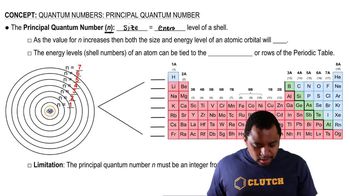
In quantum mechanics, electrons in an atom occupy discrete energy levels, denoted by quantum numbers (n). For hydrogen, these levels are quantized, meaning an electron can only exist in specific states. The transition from a lower level (n=1) to a higher level (n=∞) represents ionization, where the electron is completely removed from the atom.
추천 영상:
가이드 코스
02:55
Principal Quantum Number

Photon Energy and Wavelength

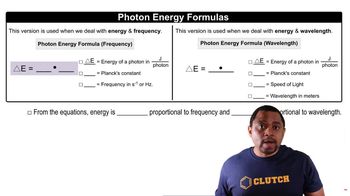
The energy of a photon is inversely related to its wavelength, described by the equation E = hc/λ, where E is energy, h is Planck's constant, c is the speed of light, and λ is the wavelength. Shorter wavelengths correspond to higher energy photons, which can provide sufficient energy to excite electrons to higher energy levels or even ionize them.
추천 영상:
가이드 코스
01:40
Photon Energy Formulas

Ionization Energy

Ionization energy is the minimum energy required to remove an electron from an atom in its gaseous state. For hydrogen, this energy corresponds to the transition from n=1 to n=∞. If light with a shorter wavelength than that used in part (b) is applied, it will have higher energy than the ionization energy, resulting in the complete removal of the electron from the hydrogen atom.
추천 영상:
가이드 코스
01:19
Ionization Energy
관련 실천
교과서 질문

In an experiment to study the photoelectric effect, a scientist measures the kinetic energy of ejected electrons as a function of the frequency of radiation hitting a metal surface. She obtains the following plot. The point labeled 'n0' corresponds to light with a wavelength of 542 nm. (a) What is the value of n0 in s - 1?

625
views
교과서 질문

The human retina has three types of receptor cones, each sensitive to a different range of wavelengths of visible light, as shown in this figure (the colors are merely to differentiate the three curves from one another; they do not indicate the actual colors represented by each curve):

(c) Explain why the sky appears blue even though all wavelengths of solar light are scattered by the atmosphere.

548
views
교과서 질문

Consider a transition in which the electron of a hydrogen atom is excited from n = 1 to n = ∞. (a) What is the end result of this transition?

764
views
교과서 질문

The series of emission lines of the hydrogen atom for which nf = 3 is called the Paschen series. (a) Determine the region of the electromagnetic spectrum in which the lines of the Paschen series are observed.

759
views
교과서 질문

Consider a transition in which the electron of a hydrogen atom is excited from n = 1 to n = ∞. (b) What is the wavelength of light that must be absorbed to accomplish this process?

1090
views
교과서 질문

Consider a transition in which the electron of a hydrogen atom is excited from n = 1 to n = ∞. (d) How are the results of parts (b) and (c) related to the plot shown in Exercise 6.88?

558
views