
Ch.6 - Electronic Structure of Atoms
Brown - Chemistry: The Central Science 14th Edition
Brown14th EditionChemistry: The Central ScienceISBN: 9780134414232당신이 사용하는 게 아니라요?교과서 변경
6장, 문제 7a

Consider the three electronic transitions in a hydrogen atom shown here, labeled A, B, and C. (a) Three electromagnetic waves, all drawn on the same scale, are also shown. Each corresponds to one of the transitions. Which electromagnetic wave (i), (ii), or (iii), is associated with electronic transition C?
Diagram of hydrogen atom transitions A, B, C with corresponding electromagnetic waves.

검증된 단계별 안내
1
Identify the energy levels involved in transition C. In the diagram, transition C is from n=3 to n=2.
Recall that the energy difference between levels determines the frequency and wavelength of the emitted photon. A larger energy difference corresponds to a higher frequency and shorter wavelength.
Compare the energy differences for transitions X, Y, and Z. Transition X (n=4 to n=3) has the smallest energy difference, transition Z (n=3 to n=2) has a moderate energy difference, and transition Y (n=4 to n=1) has the largest energy difference.
Match the energy differences to the electromagnetic waves shown. Wave (i) has the longest wavelength and lowest frequency, wave (ii) has a moderate wavelength and frequency, and wave (iii) has the shortest wavelength and highest frequency.
Determine which wave corresponds to transition C (n=3 to n=2). Since transition C has a moderate energy difference, it should correspond to wave (ii), which has a moderate wavelength and frequency.

비슷한 문제에 대한 검증된 영상 답변:

이 영상 해법은 위 문제에 도움이 된다고 튜터들이 추천한 것입니다.
영상 길이:
1m
도움이 되었나요?

주요 개념

질문에 올바르게 답하기 위해 반드시 이해해야 하는 핵심 개념들은 다음과 같습니다.

Electronic Transitions

Electronic transitions refer to the movement of an electron between different energy levels in an atom. In a hydrogen atom, these transitions occur when an electron absorbs or emits energy, typically in the form of electromagnetic radiation, as it moves from a lower energy level to a higher one or vice versa. The specific energy difference between levels determines the wavelength of the emitted or absorbed light.
추천 영상:
가이드 코스
00:53
Electron Configurations Of Transition Metals Example

Energy Levels and Quantum Numbers

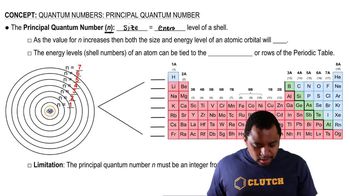
Energy levels in an atom are quantized states defined by quantum numbers, which describe the electron's energy and position. For hydrogen, the principal quantum number (n) indicates the energy level, with lower values corresponding to closer proximity to the nucleus. The transitions between these levels result in the emission or absorption of photons, with the energy of the photon being equal to the difference in energy between the two levels.
추천 영상:
가이드 코스
02:55
Principal Quantum Number

Electromagnetic Spectrum

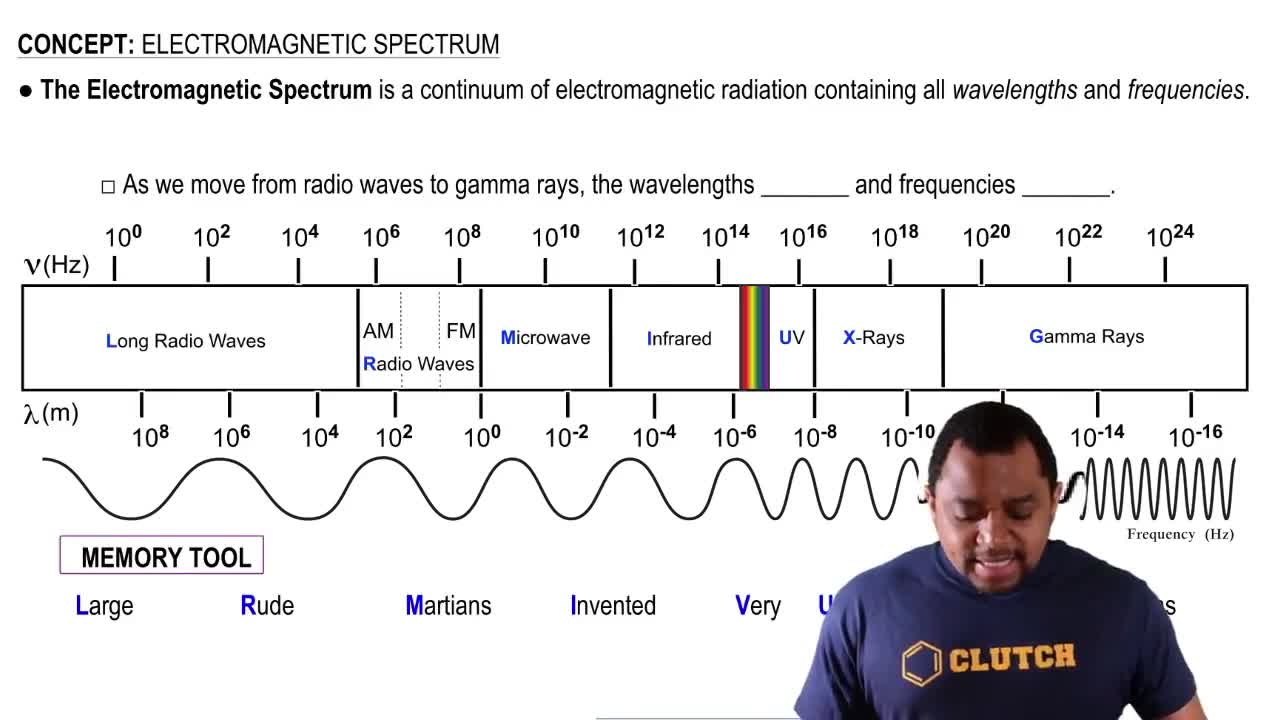
The electromagnetic spectrum encompasses all types of electromagnetic radiation, ranging from radio waves to gamma rays. Each type of radiation is characterized by its wavelength and frequency, which are inversely related. In the context of electronic transitions, the wavelength of the emitted or absorbed light corresponds to the energy difference between the electron's initial and final states, allowing us to identify which electromagnetic wave corresponds to a specific transition.
추천 영상:
가이드 코스
02:53
Electromagnetic Spectrum
관련 실천
교과서 질문

Consider the three electronic transitions in a hydrogen atom shown here, labeled A, B, and C. (c) Calculate the wavelength of the photon emitted for each transition. Do any of these transitions lead to the emission of visible light? If so which one(s)?

Calculate the wavelength of the photon emitted for transition B.

969
views
교과서 질문

Consider the three electronic transitions in a hydrogen atom shown here, labeled A, B, and C. (b) Calculate the energy of the photon emitted for each transition.

Calculate the energy of the photon emitted for transition C.

413
views
교과서 질문

Consider a fictitious one-dimensional system with one electron. The wave function for the electron, drawn below, is c1x2 = sin x from x = 0 to x = 2p. (b) At what value or values of x will there be the greatest probability of finding the electron?

526
views
교과서 질문

The familiar phenomenon of a rainbow results from the diffraction of sunlight through raindrops. (a) Does the wavelength of light increase or decrease as we proceed outward from the innermost band of the rainbow?

338
views
교과서 질문

Stars do not all have the same temperature. The color of light emitted by stars is characteristic of the light emitted by hot objects. Telescopic photos of three stars are shown below: (i) the Sun, which is classified as a yellow star, (ii) Rigel, in the constellation Orion, which is classified as a blue-white star, and (iii) Betelgeuse, also in Orion, which is classified as a red star. (a) Place these three stars in order of increasing temperature. (i) sun (ii) Rigel (iii) Betelguese

714
views
교과서 질문

A certain quantum-mechanical system has the energy levels shown in the accompanying diagram. The energy levels are indexed by a single quantum number n that is an integer. (b) Which quantum numbers are involved in the transition that requires the least energy?

590
views