
Ch.6 - Electronic Structure of Atoms
Brown - Chemistry: The Central Science 14th Edition
Brown14th EditionChemistry: The Central ScienceISBN: 9780134414232당신이 사용하는 게 아니라요?교과서 변경
6장, 문제 114

(d) Treating bismuth with fluorine gas forms BiF5. Use the electron configuration of Bi to explain the formation of a compound with this formulation.

검증된 단계별 안내
1
Identify the electron configuration of bismuth (Bi). Bismuth is element 83, so its electron configuration is [Xe] 4f14 5d10 6s2 6p3.
Understand the oxidation state of Bi in BiF5. In BiF5, bismuth must achieve a +5 oxidation state to balance the five -1 charges from the fluorine atoms, each contributing one electron.
Consider the electron removal process for Bi to achieve the +5 state. Electrons will be removed from the outermost p and s orbitals. From Bi's electron configuration, the electrons removed are the two 6s electrons and three 6p electrons.
Analyze the stability of the +5 oxidation state in BiF5. The removal of these electrons results in a completely filled 5d subshell, which contributes to the stability of the +5 oxidation state in bismuth.
Examine the role of fluorine. Fluorine (F), being highly electronegative, attracts electrons towards itself, facilitating the oxidation of Bi to Bi(+5) and the formation of BiF5.

비슷한 문제에 대한 검증된 영상 답변:

이 영상 해법은 위 문제에 도움이 된다고 튜터들이 추천한 것입니다.
영상 길이:
3m
도움이 되었나요?

주요 개념

질문에 올바르게 답하기 위해 반드시 이해해야 하는 핵심 개념들은 다음과 같습니다.

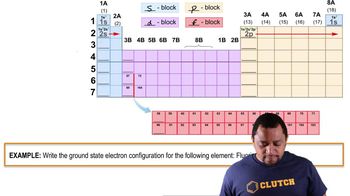
Electron Configuration

Electron configuration describes the distribution of electrons in an atom's orbitals. For bismuth (Bi), the electron configuration is [Xe] 4f14 5d10 6s2 6p3, indicating it has five valence electrons. Understanding this configuration is crucial for predicting how bismuth will interact with other elements, such as fluorine, to form compounds.
추천 영상:
가이드 코스
01:33
Electron Configuration Example

Ionic Bonding

Ionic bonding occurs when atoms transfer electrons to achieve stable electron configurations, typically between metals and nonmetals. In the case of bismuth and fluorine, bismuth can lose its three p electrons, while fluorine, a highly electronegative element, gains electrons to form BiF5. This transfer leads to the formation of positively charged bismuth ions and negatively charged fluoride ions.
추천 영상:

Oxidation States

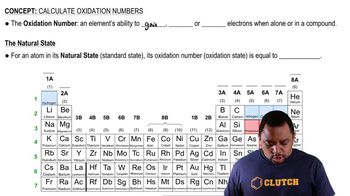
The oxidation state of an element indicates the degree of oxidation or reduction it has undergone in a compound. In BiF5, bismuth has an oxidation state of +5, meaning it has lost five electrons. This high oxidation state is significant as it reflects bismuth's ability to form stable compounds with highly electronegative elements like fluorine, which stabilizes the overall structure of the compound.
추천 영상:
가이드 코스
02:42
Oxidation Numbers