
Ch.6 - Electronic Structure of Atoms
Brown - Chemistry: The Central Science 14th Edition
Brown14th EditionChemistry: The Central ScienceISBN: 9780134414232당신이 사용하는 게 아니라요?교과서 변경
6장, 문제 11a

Four possible electron configurations for a carbon atom are shown below, but only one schematic represents the correct configuration for a carbon atom in its ground state. Which one is the correct electron configuration?
Four electron configurations for a carbon atom, only one is correct for its ground state.

검증된 단계별 안내
1
Step 1: Recall the electron configuration for a carbon atom in its ground state. Carbon has an atomic number of 6, which means it has 6 electrons.
Step 2: Write the electron configuration for carbon: 1s^2 2s^2 2p^2.
Step 3: Apply the Aufbau principle, which states that electrons fill orbitals starting with the lowest energy level first. Thus, the 1s orbital is filled first, followed by the 2s orbital, and then the 2p orbitals.
Step 4: Apply Hund's rule, which states that electrons will fill degenerate orbitals (orbitals of the same energy) singly before pairing up. Therefore, the two electrons in the 2p orbitals will occupy separate orbitals.
Step 5: Compare the given electron configurations with the correct configuration based on the principles above. Identify the configuration that matches 1s^2 2s^2 2p^2 with the 2p electrons in separate orbitals.

비슷한 문제에 대한 검증된 영상 답변:

이 영상 해법은 위 문제에 도움이 된다고 튜터들이 추천한 것입니다.
영상 길이:
2m
도움이 되었나요?

주요 개념

질문에 올바르게 답하기 위해 반드시 이해해야 하는 핵심 개념들은 다음과 같습니다.

Electron Configuration

Electron configuration describes the distribution of electrons in an atom's orbitals. For carbon, which has six electrons, the correct ground state configuration is 1s² 2s² 2p². This notation indicates that there are two electrons in the 1s orbital, two in the 2s orbital, and two in the 2p orbitals, following the Aufbau principle.
추천 영상:
가이드 코스
01:33
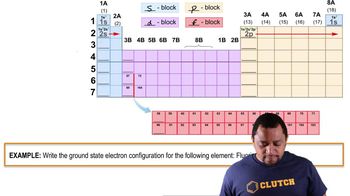
Electron Configuration Example

Pauli Exclusion Principle

The Pauli Exclusion Principle states that no two electrons in an atom can have the same set of four quantum numbers. This means that each orbital can hold a maximum of two electrons with opposite spins. Understanding this principle is crucial for determining the correct electron configuration, as it dictates how electrons fill the available orbitals.
추천 영상:
가이드 코스
02:05
Uncertainty Principle Formula

Hund's Rule

Hund's Rule states that electrons will occupy degenerate orbitals (orbitals of the same energy) singly and with parallel spins before pairing up. This rule helps minimize electron-electron repulsion and is essential for predicting the correct arrangement of electrons in the 2p orbitals of carbon, where two electrons will occupy separate p orbitals before pairing.
추천 영상:
가이드 코스
00:28
Solubility Rules