Ch.6 - Electronic Structure of Atoms
Brown - Chemistry: The Central Science 14th Edition
Brown14th EditionChemistry: The Central ScienceISBN: 9780134414232당신이 사용하는 게 아니라요?교과서 변경
6장, 문제 76f

Write the condensed electron configurations for the following atoms and indicate how many unpaired electrons each has: (f) Lu.

검증된 단계별 안내
1
Identify the atomic number of Lutetium (Lu) from the periodic table, which is 71.
Write the electron configuration for Lu. Start from the nearest noble gas with a lower atomic number, which is Xenon (Xe), and then add the remaining electrons to the orbitals in the order of increasing energy levels.
The electron configuration of Lu starting from Xe is: [Xe] 6s^2 4f^14 5d^1.
Condense the electron configuration by incorporating the noble gas notation and the filled subshells: [Xe] 4f^14 5d^1 6s^2.
Determine the number of unpaired electrons by examining the electron configuration. In Lu, the 5d orbital has 1 electron, which is unpaired, resulting in one unpaired electron.

비슷한 문제에 대한 검증된 영상 답변:

이 영상 해법은 위 문제에 도움이 된다고 튜터들이 추천한 것입니다.
영상 길이:
4m

주요 개념

질문에 올바르게 답하기 위해 반드시 이해해야 하는 핵심 개념들은 다음과 같습니다.

Electron Configuration

Electron configuration describes the distribution of electrons in an atom's orbitals. It is represented using a notation that indicates the energy levels and sublevels occupied by electrons, following the Aufbau principle, Pauli exclusion principle, and Hund's rule. For example, the electron configuration of Lutetium (Lu) is [Xe] 6s² 4f¹⁴, showing how electrons fill the available orbitals.
추천 영상:
가이드 코스
01:33
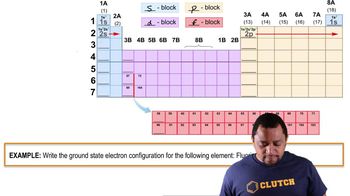
Electron Configuration Example

Unpaired Electrons

Unpaired electrons are those that occupy an orbital alone rather than in pairs. The presence of unpaired electrons is crucial for determining an atom's magnetic properties and reactivity. In the case of Lutetium, it has no unpaired electrons in its ground state configuration, as all its electrons are paired in the 4f and 6s orbitals.
추천 영상:
가이드 코스
04:44
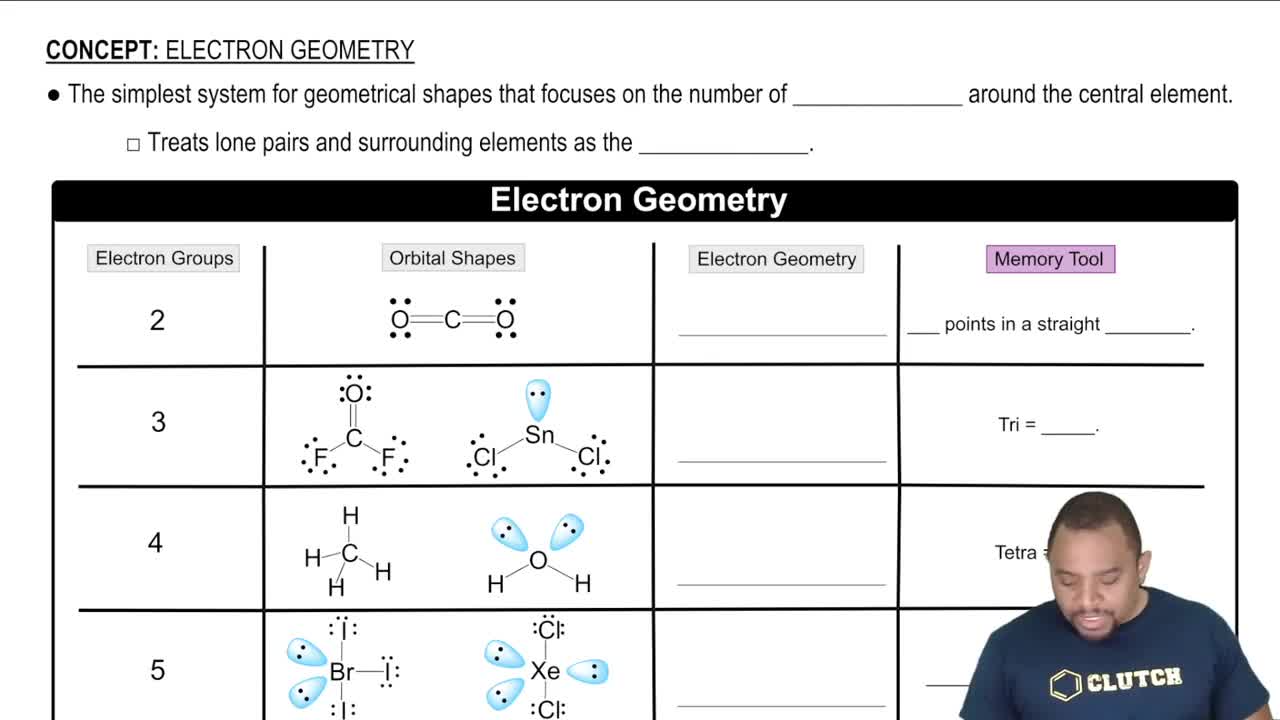
Electron Geometry

Hund's Rule

Hund's Rule states that electrons will fill degenerate orbitals (orbitals of the same energy) singly before pairing up. This principle helps minimize electron-electron repulsion and stabilizes the atom. Understanding this rule is essential for predicting the number of unpaired electrons in an atom, which is particularly relevant when analyzing transition metals and lanthanides like Lutetium.
추천 영상:
가이드 코스
00:28
Solubility Rules