Ch.7 - Periodic Properties of the Elements
Brown - Chemistry: The Central Science 14th Edition
Brown14th EditionChemistry: The Central ScienceISBN: 9780134414232당신이 사용하는 게 아니라요?교과서 변경
7장, 문제 55

(a) Does metallic character increase, decrease, or remain unchanged as one goes from left to right across a row of the periodic table? (b) Does metallic character increase, decrease, or remain unchanged as one goes down a column of the periodic table?

검증된 단계별 안내
1
Step 1: Understand the concept of metallic character. Metallic character refers to the tendency of an element to lose electrons and form positive ions (cations). Elements with high metallic character are typically good conductors of electricity and heat, have a shiny appearance, and are malleable and ductile.
Step 2: Analyze the trend across a period (row) in the periodic table. As you move from left to right across a period, elements generally become less metallic. This is because the number of protons in the nucleus increases, which leads to a stronger attraction between the nucleus and the electrons, making it harder for the atoms to lose electrons.
Step 3: Analyze the trend down a group (column) in the periodic table. As you move down a group, the metallic character generally increases. This is because the atomic size increases, and the outer electrons are further from the nucleus, which reduces the effective nuclear charge experienced by these electrons, making it easier for the atoms to lose electrons.
Step 4: Relate these trends to specific examples. For instance, in the second period, lithium (Li) is more metallic than beryllium (Be), and in the alkali metal group, lithium (Li) is less metallic than cesium (Cs).
Step 5: Summarize the trends. Across a period, metallic character decreases from left to right. Down a group, metallic character increases. These trends are due to changes in atomic size and effective nuclear charge.

주요 개념

질문에 올바르게 답하기 위해 반드시 이해해야 하는 핵심 개념들은 다음과 같습니다.

Metallic Character

Metallic character refers to the set of properties typically associated with metals, including conductivity, malleability, ductility, and luster. Elements with high metallic character tend to lose electrons easily, forming positive ions. This property is influenced by an element's position in the periodic table, which affects its atomic structure and behavior.
추천 영상:
가이드 코스
00:56
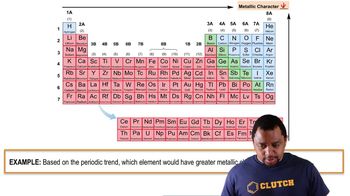
Metallic Character Example

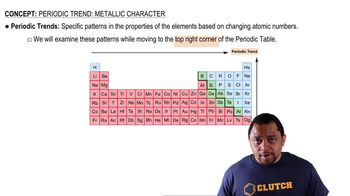
Periodic Trends

Periodic trends are predictable patterns observed in the periodic table, such as atomic radius, ionization energy, and electronegativity. As one moves from left to right across a period, elements generally become less metallic due to increasing nuclear charge, which attracts electrons more strongly. Conversely, moving down a group, atomic size increases, often leading to a greater metallic character.
추천 영상:
가이드 코스
00:38
Periodic Trends

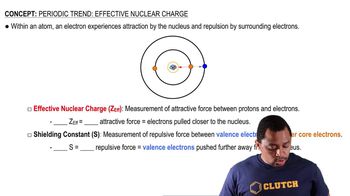
Effective Nuclear Charge

Effective nuclear charge (Z_eff) is the net positive charge experienced by an electron in a multi-electron atom. It accounts for the shielding effect of inner electrons, which reduces the full nuclear charge felt by outer electrons. As Z_eff increases across a period, the attraction between the nucleus and valence electrons strengthens, leading to a decrease in metallic character.
추천 영상:
가이드 코스
01:51
Effective Nuclear Charge