
Which of the following statements about effective nuclear charge for the outermost valence electron of an atom is incorrect? (i) The effective nuclear charge can be thought of as the true nuclear charge minus a screening constant due to the other electrons in the atom. (ii) Effective nuclear charge increases going left to right across a row of the periodic table. (iii) Valence electrons screen the nuclear charge more effectively than do core electrons. (iv) The effective nuclear charge shows a sudden decrease when we go from the end of one row to the beginning of the next row of the periodic table. (v) The change in effective nuclear charge going down a column of the periodic table is generally less than that going across a row of the periodic table
Ch.7 - Periodic Properties of the Elements

Brown14th EditionChemistry: The Central ScienceISBN: 9780134414232
당신이 사용하는 게 아니라요?교과서 변경다른 교과서를 선택하세요
TOC.tableOfContents
- Ch.1 - Introduction: Matter, Energy, and Measurement177
- Ch.2 - Atoms, Molecules, and Ions231
- Ch.3 - Chemical Reactions and Reaction Stoichiometry216
- Ch.4 - Reactions in Aqueous Solution189
- Ch.5 - Thermochemistry175
- Ch.6 - Electronic Structure of Atoms168
- Ch.7 - Periodic Properties of the Elements150
- Ch.8 - Basic Concepts of Chemical Bonding177
- Ch.9 - Molecular Geometry and Bonding Theories200
- Ch.10 - Gases179
- Ch.11 - Liquids and Intermolecular Forces113
- Ch.12 - Solids and Modern Materials154
- Ch.13 - Properties of Solutions157
- Ch.14 - Chemical Kinetics199
- Ch.15 - Chemical Equilibrium128
- Ch.16 - Acid-Base Equilibria164
- Ch.17 - Additional Aspects of Aqueous Equilibria163
- Ch.18 - Chemistry of the Environment105
- Ch.19 - Chemical Thermodynamics164
- Ch.20 - Electrochemistry171
- Ch.21 - Nuclear Chemistry122
- Ch.22 - Chemistry of the Nonmetals82
- Ch.23 - Transition Metals and Coordination Chemistry79
- Ch.24 - The Chemistry of Life: Organic and Biological Chemistry16
7장, 문제 15a
Detailed calculations show that the value of Zeff for the outermost electrons in Na and K atoms is 2.51+ and 3.49+, respectively. (a) What value do you estimate for Zeff experienced by the outermost electron in both Na and K by assuming core electrons contribute 1.00 and valence electrons contribute 0.00 to the screening constant?
 검증된 단계별 안내
1
Identify the atomic numbers of sodium (Na) and potassium (K). Sodium has an atomic number of 11, and potassium has an atomic number of 19.
Determine the number of core electrons for each element. For Na, the core electrons are the 1s, 2s, and 2p electrons, totaling 10. For K, the core electrons are the 1s, 2s, 2p, 3s, and 3p electrons, totaling 18.
Apply the formula for effective nuclear charge (Z_eff): Z_eff = Z - S, where Z is the atomic number and S is the screening constant. The screening constant S is calculated by assuming each core electron contributes 1.00 and each valence electron contributes 0.00.
Calculate the screening constant S for Na: S = 10 (since there are 10 core electrons). For K: S = 18 (since there are 18 core electrons).
Estimate Z_eff for Na and K using the formula: For Na, Z_eff = 11 - 10. For K, Z_eff = 19 - 18.
비슷한 문제에 대한 검증된 영상 답변:
이 영상 해법은 위 문제에 도움이 된다고 튜터들이 추천한 것입니다.
주요 개념
질문에 올바르게 답하기 위해 반드시 이해해야 하는 핵심 개념들은 다음과 같습니다.
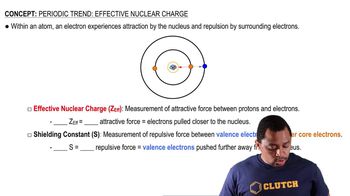
Effective Nuclear Charge (Zeff)
Effective Nuclear Charge (Zeff) is the net positive charge experienced by an electron in a multi-electron atom. It accounts for the actual nuclear charge (the number of protons) and the shielding effect caused by other electrons. The greater the Zeff, the stronger the attraction between the nucleus and the outermost electrons, influencing atomic size and ionization energy.
추천 영상:
가이드 코스
 01:51
01:51
Effective Nuclear Charge
Shielding Effect
The shielding effect refers to the phenomenon where inner electrons partially block the attraction between the nucleus and the outermost electrons. This results in a lower effective nuclear charge felt by the valence electrons. In calculations, core electrons are often assigned a specific contribution to the screening constant, which helps estimate the Zeff for outer electrons.
추천 영상:
가이드 코스
 02:31
02:31Photoelectric Effect
Valence and Core Electrons
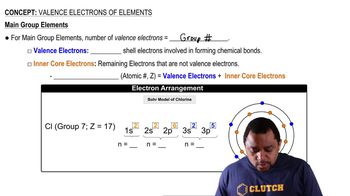
Electrons in an atom are categorized as valence or core electrons. Valence electrons are those in the outermost shell and are involved in chemical bonding, while core electrons are located in inner shells and do not participate in bonding. Understanding the distinction between these two types of electrons is crucial for calculating Zeff, as they contribute differently to the shielding effect.
추천 영상:
가이드 코스
 02:32
02:32Main Group Elements Valence Electrons
관련 실천
교과서 질문
2661
views
교과서 질문
Detailed calculations show that the value of Zeff for the outermost electrons in Na and K atoms is 2.51+ and 3.49+, respectively. (e) Predict Zeff for the outermost electrons in the Rb atom based on the calculations for Na and K.
1070
views
교과서 질문
Among the elements N, O, P, and S, which element or elements
have the smallest effect nuclear charge if we use Equation
7.1 to calculate Zeff? Which element or elements have
the largest effective nuclear charge?
1048
views
교과서 질문
Detailed calculations show that the value of Zeff for the outermost electrons in Na and K atoms is 2.51+ and 3.49+, respectively. (b) What values do you estimate for Zeff using Slater’s rules?