

Ch.7 - Periodic Properties of the Elements
Brown - Chemistry: The Central Science 14th Edition
Brown14th EditionChemistry: The Central ScienceISBN: 9780134414232당신이 사용하는 게 아니라요?교과서 변경
7장, 문제 109d

Moseley established the concept of atomic number by studying X rays emitted by the elements. The X rays emitted by some of the elements have the following wavelengths: Element Wavelength (pm) Ne 1461 Ca 335.8 Zn 143.5 Zr 78.6 Sn 49.1 (d) Use the result from part (b) to predict the X-ray wavelength emitted by iron.

검증된 단계별 안내
1
Step 1: Understand that Moseley's law states that the square root of the frequency of the X-rays emitted by an element is directly proportional to the atomic number of the element. This relationship can be expressed as: √ν = a(Z - b), where ν is the frequency, Z is the atomic number, a and b are constants.
Step 2: Convert the given wavelengths to frequency using the formula ν = c/λ, where c is the speed of light and λ is the wavelength. Remember that the speed of light is approximately 3.00 x 10^8 m/s and you need to convert the wavelengths from picometers to meters.
Step 3: Plot the square root of the frequencies against the atomic numbers of the given elements. From this plot, determine the constants a and b in Moseley's law.
Step 4: Use the atomic number of iron (26) and the constants a and b determined in the previous step to calculate the frequency of the X-rays emitted by iron using Moseley's law.
Step 5: Convert the calculated frequency back to wavelength using the formula λ = c/ν. This will give you the predicted X-ray wavelength emitted by iron.

비슷한 문제에 대한 검증된 영상 답변:

이 영상 해법은 위 문제에 도움이 된다고 튜터들이 추천한 것입니다.
영상 길이:
12m

주요 개념

질문에 올바르게 답하기 위해 반드시 이해해야 하는 핵심 개념들은 다음과 같습니다.

Atomic Number

The atomic number is a fundamental property of an element, defined as the number of protons in the nucleus of an atom. It determines the element's identity and its position in the periodic table. Moseley's work demonstrated that the atomic number, rather than atomic mass, is the correct basis for organizing the elements, as it correlates with the wavelengths of X-rays emitted by the elements.
추천 영상:

X-ray Emission

X-ray emission occurs when high-energy electrons collide with atoms, causing the ejection of inner-shell electrons. This creates vacancies that are filled by electrons from higher energy levels, resulting in the release of energy in the form of X-rays. The wavelengths of these emitted X-rays are characteristic of the element and can be used to infer information about its atomic structure.
추천 영상:
가이드 코스
01:35
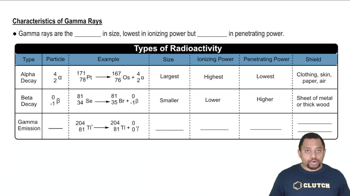
Characteristics of Gamma Rays

Wavelength and Energy Relationship

The wavelength of electromagnetic radiation is inversely related to its energy, as described by the equation E = hc/λ, where E is energy, h is Planck's constant, c is the speed of light, and λ is the wavelength. Shorter wavelengths correspond to higher energy photons. This relationship is crucial for predicting the X-ray wavelengths of elements based on their atomic numbers, as higher atomic numbers typically result in shorter wavelengths.
추천 영상:
가이드 코스
00:31
Frequency-Wavelength Relationship
관련 실천
교과서 질문

One way to measure ionization energies is ultraviolet photoelectron spectroscopy (PES), a technique based on the photoelectric effect. (Section 6.2) In PES, monochromatic light is directed onto a sample, causing electrons to be emitted. The kinetic energy of the emitted electrons is measured. The difference between the energy of the photons and the kinetic energy of the electrons corresponds to the energy needed to remove the electrons (that is, the ionization energy). Suppose that a PES experiment is performed in which mercury vapor is irradiated with ultraviolet light of wavelength 58.4 nm. (c) The kinetic energy of the emitted electrons is measured to be 1.72 × 10⁻¹⁸ J. What is the first ionization energy of Hg, in kJ/mol?

561
views
교과서 질문

One way to measure ionization energies is ultraviolet photoelectron spectroscopy (PES), a technique based on the photoelectric effect. (Section 6.2) In PES, monochromatic light is directed onto a sample, causing electrons to be emitted. The kinetic energy of the emitted electrons is measured. The difference between the energy of the photons and the kinetic energy of the electrons corresponds to the energy needed to remove the electrons (that is, the ionization energy). Suppose that a PES experiment is performed in which mercury vapor is irradiated with ultraviolet light of wavelength 58.4 nm. (b) Write an equation that shows the process corresponding to the first ionization energy of Hg.

교과서 질문

Moseley established the concept of atomic number by studying X rays emitted by the elements. The X rays emitted by some of the elements have the following wavelengths: Element Wavelength (pm) Ne 1461 Ca 335.8 Zn 143.5 Zr 78.6 Sn 49.1 (e) A particular element emits X rays with a wavelength of 98.0 pm. What element do you think it is?

교과서 질문

We will see in Chapter 12 that semiconductors are materials that conduct electricity better than nonmetals but not as well as metals. The only two elements in the periodic table that are technologically useful semiconductors are silicon and germanium. Integrated circuits in computer chips today are based on silicon. Compound semiconductors are also used in the electronics industry. Examples are gallium arsenide, GaAs; gallium phosphide, GaP; cadmium sulfide, CdS; and cadmium selenide, CdSe. (b) Workers in the semiconductor industry refer to 'II–VI' and 'III–V' materials, using Roman numerals. Can you identify which compound semiconductors are II–VI and which are III–V? (c) Suggest other compositions of compound semiconductors based on the positions of their elements in the periodic table.

297
views
교과서 질문

Moseley established the concept of atomic number by studying X rays emitted by the elements. The X rays emitted by some of the elements have the following wavelengths: Element Wavelength (pm) Ne 1461 Ca 335.8 Zn 143.5 Zr 78.6 Sn 49.1 (b) Plot the square root of n versus the atomic number of the element. What do you observe about the plot? (e) A particular element emits X rays with a wavelength of 98.0 pm. What element do you think it is?

427
views
교과서 질문

Moseley established the concept of atomic number by studying X rays emitted by the elements. The X rays emitted by some of the elements have the following wavelengths: Element Wavelength (pm) Ne 1461 Ca 335.8 Zn 143.5 Zr 78.6 Sn 49.1 (a) Calculate the frequency, n, of the X rays emitted by each of the elements, in Hz.

789
views