Ch.7 - Periodic Properties of the Elements
Brown - Chemistry: The Central Science 14th Edition
Brown14th EditionChemistry: The Central ScienceISBN: 9780134414232당신이 사용하는 게 아니라요?교과서 변경
7장, 문제 72

Potassium and hydrogen react to form the ionic compound potassium hydride. (c) Based on your calculated energy changes in (b), which of these reactions is energetically more favorable (or less unfavorable)? (d) Is your answer to (c) consistent with the description of potassium hydride as containing hydride ions?

검증된 단계별 안내
1
To determine which reaction is energetically more favorable, compare the calculated energy changes from part (b) for the formation of potassium hydride. The reaction with the lower energy change (more negative) is more favorable.
Recall that the formation of an ionic compound involves the transfer of electrons. Potassium (K) loses one electron to form K+, and hydrogen (H) gains one electron to form H- (hydride ion).
Consider the lattice energy of potassium hydride, which is the energy released when gaseous ions combine to form the ionic solid. A more negative lattice energy indicates a more stable ionic compound.
Check if the calculated energy changes align with the concept of hydride ions. Hydride ions (H-) are known for their high electron affinity, which should be reflected in the energy calculations.
Evaluate if the description of potassium hydride as containing hydride ions is consistent with the energy favorability. If the reaction forming hydride ions is more favorable, it supports the description.

주요 개념

질문에 올바르게 답하기 위해 반드시 이해해야 하는 핵심 개념들은 다음과 같습니다.

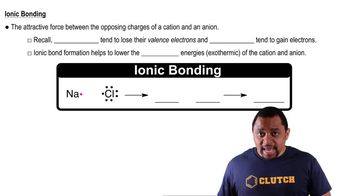
Ionic Bonding

Ionic bonding occurs when atoms transfer electrons, resulting in the formation of charged ions. In the case of potassium hydride, potassium (K) donates an electron to hydrogen (H), creating K+ and H- ions. The electrostatic attraction between these oppositely charged ions leads to the formation of the ionic compound, which is characterized by high melting points and electrical conductivity in molten or dissolved states.
추천 영상:

Energetics of Reactions

The energetics of a reaction refers to the changes in energy that occur during the reaction process. This includes the energy required to break bonds in the reactants and the energy released when new bonds form in the products. A reaction is considered energetically favorable if it results in a net release of energy, often indicated by a negative change in Gibbs free energy, which drives the reaction towards completion.
추천 영상:
가이드 코스
01:30
Alcohol Reactions: Dehydration Reactions

Hydride Ions

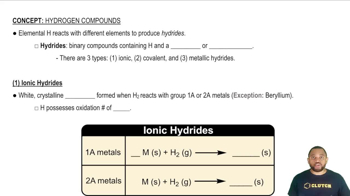
Hydride ions (H-) are formed when hydrogen gains an electron, resulting in a negatively charged ion. In potassium hydride, the presence of hydride ions indicates that hydrogen is acting as a reducing agent, allowing it to bond with potassium. The stability and properties of ionic compounds like potassium hydride are influenced by the presence of these hydride ions, which contribute to the overall lattice energy and stability of the compound.
추천 영상: