Ch.7 - Periodic Properties of the Elements
Brown - Chemistry: The Central Science 14th Edition
Brown14th EditionChemistry: The Central ScienceISBN: 9780134414232당신이 사용하는 게 아니라요?교과서 변경
7장, 문제 17

Which will experience the greater effect nuclear charge, the electrons in the n = 2 shell in F or the n = 2 shell in B? Which will be closer to the nucleus?

검증된 단계별 안내
1
Step 1: Understand the concept of nuclear charge. The nuclear charge is the total charge of all the protons in the nucleus of an atom. It is equal to the atomic number of the atom. The greater the nuclear charge, the stronger the force of attraction between the nucleus and the electrons.
Step 2: Compare the atomic numbers of Fluorine (F) and Boron (B). Fluorine has an atomic number of 9, meaning it has 9 protons, while Boron has an atomic number of 5, meaning it has 5 protons.
Step 3: Determine the effect of nuclear charge on the electrons in the n = 2 shell. The electrons in the n = 2 shell of Fluorine will experience a greater nuclear charge than the electrons in the n = 2 shell of Boron because Fluorine has more protons.
Step 4: Understand the concept of electron proximity to the nucleus. The greater the nuclear charge, the closer the electrons will be to the nucleus due to the stronger force of attraction.
Step 5: Determine which electrons will be closer to the nucleus. The electrons in the n = 2 shell of Fluorine will be closer to the nucleus than the electrons in the n = 2 shell of Boron because they experience a greater nuclear charge.

비슷한 문제에 대한 검증된 영상 답변:

이 영상 해법은 위 문제에 도움이 된다고 튜터들이 추천한 것입니다.
영상 길이:
2m
도움이 되었나요?

주요 개념

질문에 올바르게 답하기 위해 반드시 이해해야 하는 핵심 개념들은 다음과 같습니다.

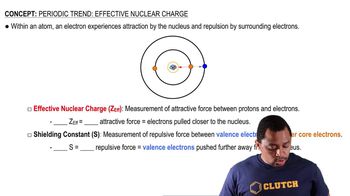
Effective Nuclear Charge (Z_eff)

Effective nuclear charge refers to the net positive charge experienced by an electron in an atom. It accounts for the actual nuclear charge (the number of protons) and the shielding effect of inner-shell electrons. In general, as the effective nuclear charge increases, electrons are pulled closer to the nucleus, affecting their energy levels and stability.
추천 영상:
가이드 코스
01:51
Effective Nuclear Charge

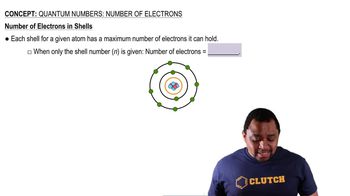
Electron Shells and Energy Levels

Electron shells are defined energy levels where electrons reside around the nucleus of an atom. The principal quantum number (n) indicates the shell's energy level, with lower numbers corresponding to shells closer to the nucleus. Electrons in lower energy levels experience a stronger attraction to the nucleus, influencing their stability and reactivity.
추천 영상:
가이드 코스
00:46
Number of Electrons in Shells

Comparison of Atomic Structure in Elements

When comparing elements like fluorine (F) and boron (B), it's essential to consider their atomic structure, including the number of protons and electron configurations. Fluorine has a higher atomic number than boron, resulting in a greater effective nuclear charge for its electrons. This difference affects the distance of the n = 2 electrons from the nucleus, with fluorine's electrons being closer due to the stronger nuclear attraction.
추천 영상:
가이드 코스
2:38
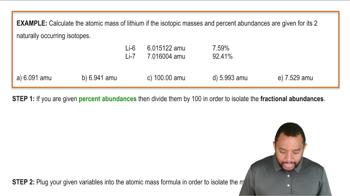
Atomic Mass Comparison Example