Consider the lattice energies of the following Group 2A compounds: BeH2, 3205 kJ/mol; MgH2, 2791 kJ/mol; CaH2, 2410 kJ/mol; SrH2, 2250 kJ/mol; BaH2, 2121 kJ/mol. (a) What is the oxidation number of H in these compounds?
Ch.8 - Basic Concepts of Chemical Bonding
8장, 문제 78
A new compound is made that has a C—N bond length of 118 pm. Is this bond likely to be a single, double, or triple C—N bond?
검증된 단계별 안내1
Step 1: Understand the typical bond lengths for C—N bonds. Single, double, and triple bonds have different bond lengths due to the number of shared electron pairs. Generally, single bonds are the longest, and triple bonds are the shortest.
Step 2: Recall the approximate bond lengths for C—N bonds: a single C—N bond is typically around 147 pm, a double C—N bond is around 130 pm, and a triple C—N bond is around 116 pm.
Step 3: Compare the given bond length of 118 pm to the typical bond lengths for C—N bonds. Determine which bond type the given length is closest to.
Step 4: Consider the nature of bond lengths: shorter bond lengths indicate stronger bonds due to more shared electrons, which is characteristic of multiple bonds (double or triple).
Step 5: Based on the comparison, infer whether the bond is more likely to be a single, double, or triple bond.
주요 개념
질문에 올바르게 답하기 위해 반드시 이해해야 하는 핵심 개념들은 다음과 같습니다.
Bond Length
Bond length is the average distance between the nuclei of two bonded atoms. It is influenced by the type of bond formed; single bonds are generally longer than double bonds, which in turn are longer than triple bonds. Understanding bond lengths helps in determining the nature of the bond between atoms.
추천 영상:
가이드 코스
Average Bond Order
Types of Covalent Bonds
Covalent bonds can be classified as single, double, or triple based on the number of shared electron pairs between atoms. A single bond involves one pair of shared electrons, a double bond involves two pairs, and a triple bond involves three pairs. Each type of bond has characteristic bond lengths, with single bonds being the longest and triple bonds the shortest.
추천 영상:
가이드 코스
Bonding Types
Electronegativity and Bond Character
Electronegativity refers to the ability of an atom to attract shared electrons in a bond. In a C—N bond, the difference in electronegativity between carbon and nitrogen can influence the bond's character and length. Understanding how electronegativity affects bond formation is essential for predicting bond types and their corresponding lengths.
추천 영상:
가이드 코스
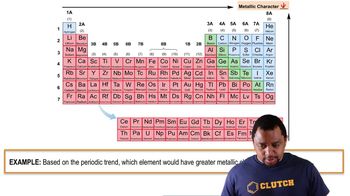
Metallic Character Example
관련 실천
교과서 질문
882
views
교과서 질문
Consider the lattice energies of the following Group 2A compounds: BeH2, 3205 kJ/mol; MgH2, 2791 kJ/mol; CaH2, 2410 kJ/mol; SrH2, 2250 kJ/mol; BaH2, 2121 kJ/mol. (d) The lattice energy of ZnH2 is 2870 kJ/mol. Considering the trend in lattice enthalpies in the Group 2 compounds, predict which Group 2 element is most similar in ionic radius to the Zn2+ ion.
1
views
교과서 질문
Draw the Lewis structure for NO+ . Is the nitrogen–
oxygen bond in NO+ longer, shorter, or the same length as the
nitrogen–oxygen bond in NO? Explain.
Draw the Lewis structure for NO+ .
1187
views
교과서 질문
Consider the lattice energies of the following Group 2A compounds: BeH2, 3205 kJ/mol; MgH2, 2791 kJ/mol; CaH2, 2410 kJ/mol; SrH2, 2250 kJ/mol; BaH2, 2121 kJ/mol. (c) Consider BeH2. Does it require 3205 kJ of energy to break one mole of the solid into its ions, or does breaking up one mole of solid into its ions release 3205 kJ of energy?
1
views