


Ch.8 - Basic Concepts of Chemical Bonding
Brown - Chemistry: The Central Science 14th Edition
Brown14th EditionChemistry: The Central ScienceISBN: 9780134414232당신이 사용하는 게 아니라요?교과서 변경
8장, 문제 31a

(a) State whether or not the bonding in each substance is likely to be covalent: (i) glucose, (ii) nitrogen, (iii) aluminum hydroxide, (iv) ammonia, (v) neon.

검증된 단계별 안내
1
To determine if the bonding in a substance is likely to be covalent, consider the types of elements involved. Covalent bonds typically form between nonmetals.
Examine glucose (C₆H₁₂O₆): Glucose is composed of carbon, hydrogen, and oxygen, all of which are nonmetals. Therefore, the bonding in glucose is likely covalent.
Consider nitrogen (N₂): Nitrogen is a diatomic molecule consisting of two nitrogen atoms, both nonmetals. The bonding in nitrogen is covalent.
Analyze aluminum hydroxide (Al(OH)₃): Aluminum is a metal, while hydroxide is composed of oxygen and hydrogen, which are nonmetals. The bonding in aluminum hydroxide is likely ionic due to the presence of a metal.
Evaluate ammonia (NH₃): Ammonia consists of nitrogen and hydrogen, both nonmetals. Thus, the bonding in ammonia is covalent.
Assess neon (Ne): Neon is a noble gas and typically does not form bonds because it is chemically inert. Therefore, there is no covalent bonding in neon.

비슷한 문제에 대한 검증된 영상 답변:

이 영상 해법은 위 문제에 도움이 된다고 튜터들이 추천한 것입니다.
영상 길이:
5m
도움이 되었나요?

주요 개념

질문에 올바르게 답하기 위해 반드시 이해해야 하는 핵심 개념들은 다음과 같습니다.

Covalent Bonding

Covalent bonding occurs when two atoms share one or more pairs of electrons, typically between nonmetals. This type of bond results in the formation of molecules, where the shared electrons allow each atom to achieve a more stable electron configuration, often resembling that of noble gases. Understanding the nature of covalent bonds is essential for determining the bonding characteristics of various substances.
추천 영상:

Molecular Structure

The molecular structure of a substance refers to the arrangement of atoms within a molecule and the types of bonds that hold them together. This structure influences the physical and chemical properties of the substance, including its reactivity and state of matter. Analyzing the molecular structure helps in identifying whether a substance is likely to exhibit covalent bonding.
추천 영상:
가이드 코스
02:08
Molecular Formula

Electronegativity

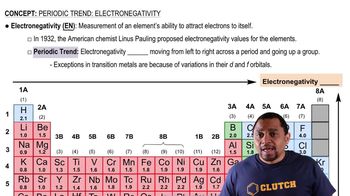
Electronegativity is a measure of an atom's ability to attract and hold onto electrons in a bond. In covalent bonds, the difference in electronegativity between the bonded atoms can indicate the bond's character; small differences suggest nonpolar covalent bonds, while larger differences can lead to polar covalent bonds. Understanding electronegativity is crucial for predicting the type of bonding in various substances.
추천 영상:
가이드 코스
02:10
Electronegativity Trends