Ch.8 - Basic Concepts of Chemical Bonding
Brown - Chemistry: The Central Science 14th Edition
Brown14th EditionChemistry: The Central ScienceISBN: 9780134414232당신이 사용하는 게 아니라요?교과서 변경
8장, 문제 99c

(c) Hydrogen peroxide is sold commercially as an aqueous solution in brown bottles to protect it from light. Calculate the longest wavelength of light that has sufficient energy to break the weakest bond in hydrogen peroxide.

검증된 단계별 안내
1
Identify the weakest bond in hydrogen peroxide (H₂O₂). The molecule consists of O-H and O-O bonds. The O-O bond is generally weaker than the O-H bond.
Determine the bond dissociation energy for the O-O bond in hydrogen peroxide. This value is typically found in tables of bond energies and is expressed in kilojoules per mole (kJ/mol).
Convert the bond dissociation energy from kJ/mol to energy per molecule in joules. Use Avogadro's number (6.022 x 10²³ molecules/mol) for this conversion. The formula is: Energy per molecule (J) = (Bond energy in kJ/mol) × (1000 J/kJ) / (Avogadro's number).
Use the energy of a photon equation to find the wavelength. The energy of a photon is given by E = hν, where h is Planck's constant (6.626 x 10⁻³⁴ J·s) and ν is the frequency. The relationship between frequency and wavelength is ν = c/λ, where c is the speed of light (3.00 x 10⁸ m/s) and λ is the wavelength.
Rearrange the equation to solve for the wavelength: λ = hc/E. Substitute the values for h, c, and the energy per molecule calculated in step 3 to find the longest wavelength of light that can break the O-O bond in hydrogen peroxide.

비슷한 문제에 대한 검증된 영상 답변:

이 영상 해법은 위 문제에 도움이 된다고 튜터들이 추천한 것입니다.
영상 길이:
5m
도움이 되었나요?

주요 개념

질문에 올바르게 답하기 위해 반드시 이해해야 하는 핵심 개념들은 다음과 같습니다.

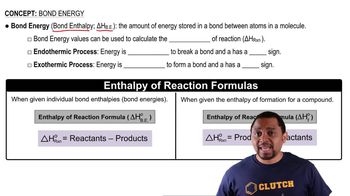
Bond Dissociation Energy

Bond dissociation energy is the energy required to break a specific bond in a molecule, resulting in the formation of two separate species. In hydrogen peroxide (H2O2), the weakest bond is typically the O-O bond, which can be broken by absorbing energy in the form of light. Understanding this concept is crucial for calculating the energy needed to break the bond and subsequently determining the wavelength of light associated with that energy.
추천 영상:

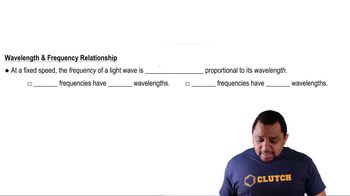
Energy-Wavelength Relationship

The energy of a photon is inversely related to its wavelength, described by the equation E = hc/λ, where E is energy, h is Planck's constant, c is the speed of light, and λ is the wavelength. This relationship allows us to calculate the wavelength of light that corresponds to a specific energy value, such as the energy required to break a bond in hydrogen peroxide. Recognizing this relationship is essential for solving the problem.
추천 영상:
가이드 코스
00:31
Frequency-Wavelength Relationship

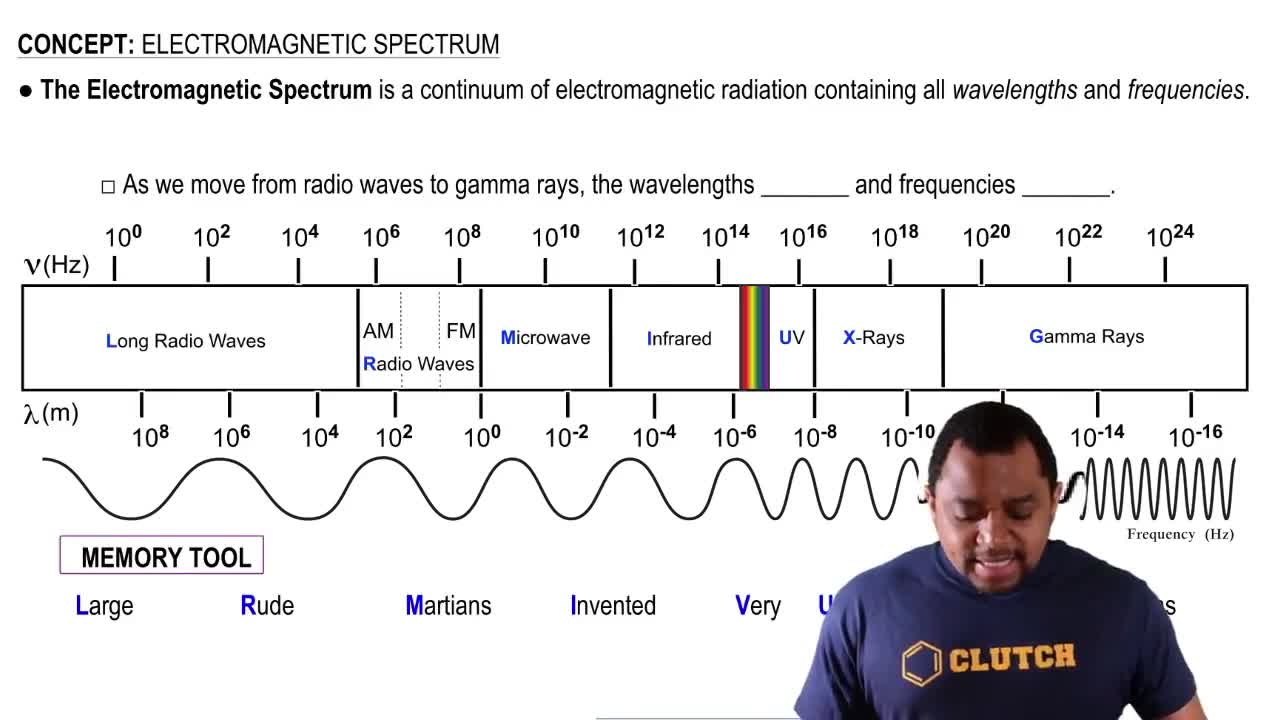
Electromagnetic Spectrum

The electromagnetic spectrum encompasses all types of electromagnetic radiation, ranging from radio waves to gamma rays, with visible light being a small portion of this spectrum. Each type of radiation has a specific wavelength and energy associated with it. Understanding where the energy required to break the bond in hydrogen peroxide falls within the electromagnetic spectrum helps in identifying the type of light that can effectively break the bond.
추천 영상:
가이드 코스
02:53
Electromagnetic Spectrum