Ch.8 - Basic Concepts of Chemical Bonding
Brown - Chemistry: The Central Science 14th Edition
Brown14th EditionChemistry: The Central ScienceISBN: 9780134414232당신이 사용하는 게 아니라요?교과서 변경
8장, 문제 12c

(c) Ti and Hf behave as though they possess the same number of valence electrons. Which of the subshells in the electron configuration of Hf behave as valence orbitals? Which behave as core orbitals?

검증된 단계별 안내
1
insert step 1> Start by writing the electron configuration for Hafnium (Hf). Hafnium has an atomic number of 72, so its electron configuration is: [Xe] 4f^{14} 5d^2 6s^2.
insert step 2> Identify the valence orbitals. Valence orbitals are the outermost orbitals that are involved in chemical bonding. For Hf, these are the 5d and 6s orbitals.
insert step 3> Identify the core orbitals. Core orbitals are the inner orbitals that are not involved in chemical bonding. For Hf, these include the 4f orbitals and all orbitals in the [Xe] core configuration.
insert step 4> Understand that the 4f orbitals are filled before the 5d orbitals, but they are considered core because they are not involved in bonding.
insert step 5> Conclude that for Hf, the 5d and 6s orbitals behave as valence orbitals, while the 4f orbitals and those in the [Xe] configuration behave as core orbitals.

비슷한 문제에 대한 검증된 영상 답변:

이 영상 해법은 위 문제에 도움이 된다고 튜터들이 추천한 것입니다.
영상 길이:
5m
도움이 되었나요?

주요 개념

질문에 올바르게 답하기 위해 반드시 이해해야 하는 핵심 개념들은 다음과 같습니다.

Valence Electrons

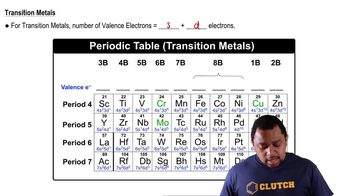
Valence electrons are the outermost electrons of an atom and are crucial for chemical bonding and reactivity. They are found in the highest energy level (or shell) of an atom and determine how an element interacts with others. In transition metals like titanium (Ti) and hafnium (Hf), the d and s orbitals can contribute to the valence shell, influencing their chemical behavior.
추천 영상:
가이드 코스
02:12
Transition Metals Valence Electrons

Electron Configuration

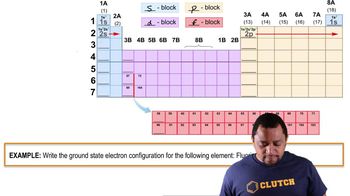
Electron configuration describes the distribution of electrons in an atom's orbitals. It is represented using a notation that indicates the energy levels and types of orbitals occupied by electrons. For Hf, the electron configuration is [Xe] 4f14 5d2 6s2, where the 5d and 6s orbitals are considered valence orbitals, while the 4f orbitals are core orbitals.
추천 영상:
가이드 코스
01:33
Electron Configuration Example

Core vs. Valence Orbitals

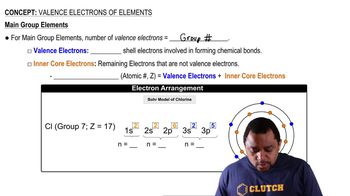
Core orbitals are the inner electrons that are not involved in bonding and are typically closer to the nucleus, while valence orbitals are the outermost orbitals that participate in chemical reactions. In Hf, the 4f orbitals are core orbitals, and the 5d and 6s orbitals are valence orbitals, which play a significant role in its chemical properties and similarities to Ti.
추천 영상:
가이드 코스
02:32
Main Group Elements Valence Electrons