Ch.8 - Basic Concepts of Chemical Bonding
Brown - Chemistry: The Central Science 14th Edition
Brown14th EditionChemistry: The Central ScienceISBN: 9780134414232당신이 사용하는 게 아니라요?교과서 변경
8장, 문제 62

For Group 13–17 elements in the third row of the periodic table and beyond, the octet rule is often not obeyed. A friend of yours says this is because these heavier elements are more likely to make double or triple bonds. Another friend of yours says that this is because the heavier elements are larger and can make bonds to more than four atoms at a time. Which friend is more correct?

검증된 단계별 안내
1
insert step 1> Consider the octet rule, which states that atoms tend to form bonds until they are surrounded by eight electrons in their valence shell. This rule is most applicable to the second row elements.
insert step 2> Recognize that for elements in the third row and beyond, the octet rule is often not strictly followed. This is due to the availability of d orbitals, which can accommodate more than eight electrons.
insert step 3> Evaluate the first friend's statement: Heavier elements can form double or triple bonds. While this is true, it is not the primary reason for the octet rule's exceptions. Double and triple bonds are more about bond strength and stability rather than exceeding the octet.
insert step 4> Evaluate the second friend's statement: Heavier elements are larger and can bond with more than four atoms. This is more accurate because larger atoms have more available orbitals (including d orbitals) that can participate in bonding, allowing them to expand their valence shell beyond eight electrons.
insert step 5> Conclude that the second friend is more correct. The ability of heavier elements to expand their valence shell and form bonds with more than four atoms is a key reason why the octet rule is not strictly followed for these elements.

비슷한 문제에 대한 검증된 영상 답변:

이 영상 해법은 위 문제에 도움이 된다고 튜터들이 추천한 것입니다.
영상 길이:
3m
도움이 되었나요?

주요 개념

질문에 올바르게 답하기 위해 반드시 이해해야 하는 핵심 개념들은 다음과 같습니다.

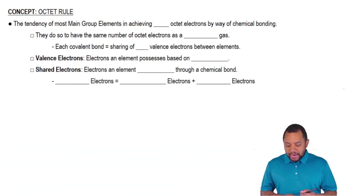
Octet Rule

The octet rule is a chemical guideline that states atoms tend to bond in such a way that they each have eight electrons in their valence shell, achieving a stable electron configuration similar to that of noble gases. While this rule is applicable to many elements, particularly those in the second period, it becomes less relevant for heavier elements in groups 13-17, which can exceed eight valence electrons due to their larger atomic size and available d-orbitals.
추천 영상:

Bonding in Heavier Elements

Heavier elements, particularly those in the third period and beyond, can form multiple bonds (double or triple) and can also utilize d-orbitals for bonding. This allows them to accommodate more than four bonds, leading to complex bonding scenarios that do not conform to the octet rule. The ability to form such bonds is influenced by their larger atomic radii and the presence of additional electron orbitals.
추천 영상:
가이드 코스
00:43
Main Group Elements: Bonding Types Example

Coordination Number

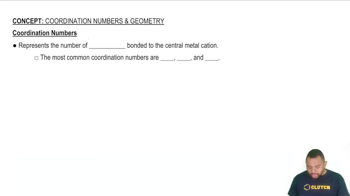
The coordination number refers to the number of atoms or ions immediately surrounding a central atom in a complex or coordination compound. For heavier elements, the coordination number can exceed four due to their larger size and the availability of d-orbitals, allowing them to bond with more than four atoms simultaneously. This characteristic is crucial in understanding the bonding behavior of these elements and their ability to form various molecular geometries.
추천 영상:
가이드 코스
00:27
Coordination Numbers