Ch.8 - Basic Concepts of Chemical Bonding
Brown - Chemistry: The Central Science 14th Edition
Brown14th EditionChemistry: The Central ScienceISBN: 9780134414232당신이 사용하는 게 아니라요?교과서 변경
8장, 문제 2b

Illustrated are four ions — A, B, X, and Y— showing their relative ionic radii. The ions shown in red carry positive charges: a 2+ charge for A and a 1+ charge for B. Ions shown in blue carry negative charges: a 1- charge for X and a 2- charge for Y. (b) Among the combinations in part (a), which leads to the ionic compound having the largest lattice energy?

검증된 단계별 안내
1
Understand that lattice energy is the energy released when ions in the gaseous state form an ionic solid. It is influenced by the charge and size of the ions.
Recall that lattice energy increases with the magnitude of the charge on the ions and decreases with the size of the ions.
Identify the charges of the ions: A (2+), B (1+), X (1-), and Y (2-). Larger charges will contribute to a higher lattice energy.
Consider the size of the ions: smaller ions will result in a higher lattice energy due to the shorter distance between them.
Evaluate the possible combinations: A with Y (2+ and 2-), A with X (2+ and 1-), B with Y (1+ and 2-), and B with X (1+ and 1-). The combination with the highest product of charges and smallest ionic radii will have the largest lattice energy.

비슷한 문제에 대한 검증된 영상 답변:

이 영상 해법은 위 문제에 도움이 된다고 튜터들이 추천한 것입니다.
영상 길이:
2m

주요 개념

질문에 올바르게 답하기 위해 반드시 이해해야 하는 핵심 개념들은 다음과 같습니다.

Ionic Radius

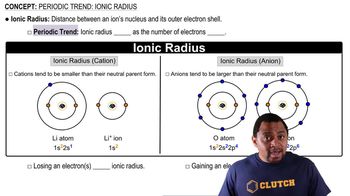
Ionic radius refers to the size of an ion in a crystal lattice. Cations (positively charged ions) are generally smaller than their parent atoms due to the loss of electrons, which reduces electron-electron repulsion. Conversely, anions (negatively charged ions) are larger because they gain electrons, increasing repulsion among them. Understanding ionic radii is crucial for predicting the stability and properties of ionic compounds.
추천 영상:

Lattice Energy

Lattice energy is the energy released when gaseous ions combine to form an ionic solid. It is a measure of the strength of the forces between the ions in an ionic compound. Larger charges and smaller ionic radii typically result in higher lattice energy, as the electrostatic attraction between oppositely charged ions increases. This concept is essential for determining the stability and solubility of ionic compounds.
추천 영상:

Charge Density

Charge density is defined as the charge of an ion divided by its volume, which is influenced by its ionic radius. Higher charge density indicates a stronger electrostatic attraction between ions, leading to greater lattice energy. In the context of ionic compounds, ions with higher charges and smaller radii will have higher charge densities, significantly affecting the overall stability and properties of the resulting compound.
추천 영상:
가이드 코스
01:56
Density Concepts