

Ch.8 - Basic Concepts of Chemical Bonding
Brown - Chemistry: The Central Science 14th Edition
Brown14th EditionChemistry: The Central ScienceISBN: 9780134414232당신이 사용하는 게 아니라요?교과서 변경
8장, 문제 58c

Mothballs are composed of naphthalene, C10H8, a molecule that consists of two six-membered rings of carbon fused along an edge, as shown in this incomplete Lewis structure:
(c) Not all of the C—C bond lengths in naphthalene are equivalent. Based on your resonance structures, how many C—C bonds in the molecule do you expect to be shorter than the others?

검증된 단계별 안내
1
Draw the Lewis structure of naphthalene, C_{10}H_{8}, showing all atoms and bonds.
Identify the resonance structures of naphthalene by moving electrons to form different double bond arrangements.
Count the number of C—C bonds in each resonance structure.
Determine which C—C bonds are double bonds in more than one resonance structure, as these will be shorter due to increased bond order.
Conclude how many C—C bonds are expected to be shorter based on their presence as double bonds in multiple resonance structures.

비슷한 문제에 대한 검증된 영상 답변:

이 영상 해법은 위 문제에 도움이 된다고 튜터들이 추천한 것입니다.
영상 길이:
2m

주요 개념

질문에 올바르게 답하기 위해 반드시 이해해야 하는 핵심 개념들은 다음과 같습니다.

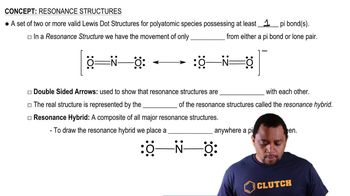
Resonance Structures

Resonance structures are different ways of drawing the same molecule that illustrate the delocalization of electrons. In naphthalene, the electrons in the C—C bonds can be shared among multiple bonds, leading to bond lengths that are not all equivalent. Understanding resonance helps predict the stability and reactivity of the molecule.
추천 영상:
가이드 코스
01:42
Resonance Structures

Bond Lengths and Strengths

Bond length refers to the distance between the nuclei of two bonded atoms. In molecules with resonance, some bonds can be shorter or longer than others due to the distribution of electron density. In naphthalene, the C—C bonds that participate in resonance are typically shorter and stronger than those that do not.
추천 영상:
가이드 코스
00:36
Average Bond Order

Delocalization of Electrons

Delocalization of electrons occurs when electrons are not associated with a single atom or bond but are spread over several atoms. In naphthalene, this delocalization results from the overlapping p-orbitals of the carbon atoms, leading to a stabilization of the molecule and affecting the bond lengths of the C—C bonds.
추천 영상:
가이드 코스
04:44
Electron Geometry