Ch.8 - Basic Concepts of Chemical Bonding
Brown - Chemistry: The Central Science 14th Edition
Brown14th EditionChemistry: The Central ScienceISBN: 9780134414232당신이 사용하는 게 아니라요?교과서 변경
8장, 문제 68a

Some chemists believe that satisfaction of the octet rule should be the top criterion for choosing the dominant Lewis structure of a molecule or ion. Other chemists believe that achieving the best formal charges should be the top criterion. Consider the dihydrogen phosphate ion, H2PO4-, in which the H atoms are bonded to O atoms. (a) What is the predicted dominant Lewis structure if satisfying the octet rule is the top criterion?

검증된 단계별 안내
1
Step 1: Begin by determining the total number of valence electrons available for the dihydrogen phosphate ion, H₂PO₄⁻. Phosphorus (P) has 5 valence electrons, each oxygen (O) has 6 valence electrons, and each hydrogen (H) has 1 valence electron. Additionally, the negative charge on the ion contributes 1 extra electron.
Step 2: Calculate the total number of valence electrons: 5 (from P) + 4 × 6 (from O) + 2 × 1 (from H) + 1 (from the negative charge) = 32 valence electrons.
Step 3: Arrange the atoms with phosphorus as the central atom, since it is less electronegative than oxygen. Connect each oxygen atom to the phosphorus atom with a single bond. Attach each hydrogen atom to one of the oxygen atoms.
Step 4: Distribute the remaining electrons to satisfy the octet rule for each atom. Start by completing the octets for the oxygen atoms, then ensure the phosphorus atom also achieves an octet. Remember that hydrogen only needs 2 electrons to be satisfied.
Step 5: Verify that all atoms satisfy the octet rule. Adjust the placement of electrons if necessary, ensuring that the total number of electrons used equals the number calculated in Step 2. The dominant Lewis structure will have all atoms satisfying the octet rule.

비슷한 문제에 대한 검증된 영상 답변:

이 영상 해법은 위 문제에 도움이 된다고 튜터들이 추천한 것입니다.
영상 길이:
1m

주요 개념

질문에 올바르게 답하기 위해 반드시 이해해야 하는 핵심 개념들은 다음과 같습니다.

Octet Rule

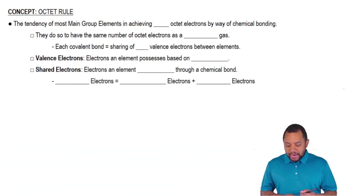
The octet rule is a chemical guideline that states atoms tend to bond in such a way that they each have eight electrons in their valence shell, achieving a stable electron configuration similar to that of noble gases. This rule is particularly relevant for main group elements and helps predict the bonding behavior and structure of molecules, including the arrangement of electrons in Lewis structures.
추천 영상:

Lewis Structures

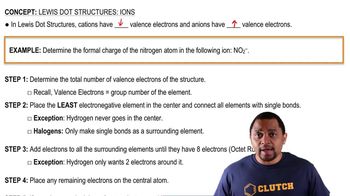
Lewis structures are diagrams that represent the bonding between atoms in a molecule and the lone pairs of electrons that may exist. They are used to visualize the arrangement of electrons and to predict the geometry and reactivity of molecules. In constructing Lewis structures, one must consider the octet rule, formal charges, and the overall charge of the molecule or ion.
추천 영상:
가이드 코스
04:28
Lewis Dot Structures: Ions

Formal Charge

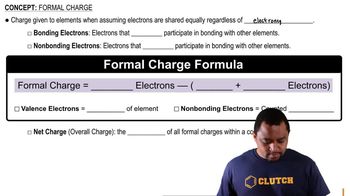
Formal charge is a theoretical charge assigned to an atom in a molecule, calculated based on the number of valence electrons, the number of non-bonding electrons, and the number of bonds. It helps in determining the most stable Lewis structure by minimizing the formal charges across the molecule. A structure with the lowest formal charges is often preferred, but it must also satisfy the octet rule for the atoms involved.
추천 영상:
관련 실천
교과서 질문

State whether each of these statements is true or false. (e) The longer the bond, the more energy is stored chemical bonds.

543
views
1
rank

교과서 질문

State whether each of these statements is true or false. (a) The longer the bond, the stronger the bond. (c) A typical double bond length is in the 500–1000 pm range.

교과서 질문

(a) Describe the molecule xenon trioxide, XeO3, using four possible Lewis structures, one each with zero, one, two, or three Xe¬O double bonds. (b) Do any of these resonance structures satisfy the octet rule for every atom in the molecule? (c) Do any of the four Lewis structures have multiple resonance structures? If so, how many resonance structures do you find? (d) Which of the Lewis structures in part (a) yields the most favorable formal charges for the molecule?

1419
views
교과서 질문

There are many Lewis structures you could draw for sulfuric acid, H2SO4 (each H is bonded to an O). (a) What Lewis structure(s) would you draw to satisfy the octet rule?

646
views
교과서 질문

There are many Lewis structures you could draw for sulfuric acid, H2SO4 (each H is bonded to an O). (b) What Lewis structure(s) would you draw to minimize formal charge?

1152
views
교과서 질문

Some chemists believe that satisfaction of the octet rule should be the top criterion for choosing the dominant Lewis structure of a molecule or ion. Other chemists believe that achieving the best formal charges should be the top criterion. Consider the dihydrogen phosphate ion, H2PO4-, in which the H atoms are bonded to O atoms. (b) What is the predicted dominant Lewis structure if achieving the best formal charges is the top criterion?

630
views