Ch.8 - Basic Concepts of Chemical Bonding
Brown - Chemistry: The Central Science 14th Edition
Brown14th EditionChemistry: The Central ScienceISBN: 9780134414232당신이 사용하는 게 아니라요?교과서 변경
8장, 문제 18a,b,c

Which ionic compound is expected to form from combining the following pairs of elements? (a) calcium and nitrogen (b) cesium and bromine (c) strontium and sulfur

검증된 단계별 안내
1
Identify the charges of the ions formed by each element: Strontium (Sr) is in Group 2 of the periodic table and typically forms a +2 cation (Sr^{2+}). Sulfur (S) is in Group 16 and typically forms a -2 anion (S^{2-}).
Determine the ratio of ions needed to balance the charges: Since Sr^{2+} and S^{2-} have equal but opposite charges, they will combine in a 1:1 ratio to balance the charges.
Write the formula of the ionic compound: Combine one Sr^{2+} ion with one S^{2-} ion to form the neutral compound SrS.
Verify the neutrality of the compound: Check that the total positive charge (+2 from Sr^{2+}) and the total negative charge (-2 from S^{2-}) sum to zero, confirming the compound is neutral.
Name the ionic compound: The name of the compound is strontium sulfide, following the convention of naming the metal (cation) first and the non-metal (anion) with an -ide suffix.

비슷한 문제에 대한 검증된 영상 답변:

이 영상 해법은 위 문제에 도움이 된다고 튜터들이 추천한 것입니다.
영상 길이:
49s
도움이 되었나요?

주요 개념

질문에 올바르게 답하기 위해 반드시 이해해야 하는 핵심 개념들은 다음과 같습니다.

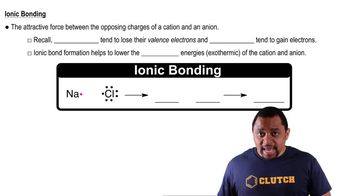
Ionic Bonding

Ionic bonding occurs when atoms transfer electrons to achieve full outer electron shells, resulting in the formation of charged ions. Typically, this happens between metals, which lose electrons and become positively charged cations, and nonmetals, which gain electrons to become negatively charged anions. The electrostatic attraction between these oppositely charged ions forms a stable ionic compound.
추천 영상:

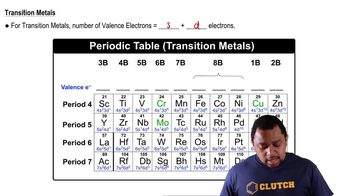
Valence Electrons

Valence electrons are the outermost electrons of an atom and play a crucial role in chemical bonding. The number of valence electrons determines how an element interacts with others, including its ability to lose, gain, or share electrons. For strontium (which has two valence electrons) and sulfur (which has six), understanding their valence electrons is essential for predicting the type of ionic compound they will form.
추천 영상:
가이드 코스
02:12
Transition Metals Valence Electrons

Formation of Ionic Compounds

The formation of ionic compounds involves the combination of cations and anions in a ratio that results in a neutral overall charge. In the case of strontium and sulfur, strontium forms a +2 cation (Sr²⁺) and sulfur forms a -2 anion (S²⁻). Therefore, one strontium ion will combine with one sulfur ion to create the ionic compound strontium sulfide (SrS), demonstrating the principle of charge balance in ionic compounds.
추천 영상:
가이드 코스
02:11
Ionic Compounds Naming