
Ch.9 - Molecular Geometry and Bonding Theories
Brown - Chemistry: The Central Science 14th Edition
Brown14th EditionChemistry: The Central ScienceISBN: 9780134414232당신이 사용하는 게 아니라요?교과서 변경
9장, 문제 121

Antibonding molecular orbitals can be used to make bonds to other atoms in a molecule. For example, metal atoms can use appropriate d orbitals to overlap with the π*2p orbitals of the carbon monoxide molecule. This is called d-π backbonding. (a) Draw a coordinate axis system in which the y-axis is vertical in the plane of the paper and the x-axis horizontal. Write 'M' at the origin to denote a metal atom. (b) Now, on the x-axis to the right of M, draw the Lewis structure of a CO molecule, with the carbon nearest the M. The CO bond axis should be on the x-axis. (c) Draw the CO π*2p orbital, with phases (see the 'Closer Look' box on phases) in the plane of the paper. Two lobes should be pointing toward M. (d) Now draw the dxy orbital of M, with phases. Can you see how they will overlap with the π*2p orbital of CO? (e) What kind of bond is being made with the orbitals between M and C, σ or π? (f) Predict what will happen to the strength of the CO bond in a metal–CO complex compared to CO alone.

검증된 단계별 안내
1
Step 1: Begin by drawing a coordinate axis system on your paper. Place the y-axis vertically and the x-axis horizontally. At the origin, where the axes intersect, write 'M' to represent the metal atom.
Step 2: On the x-axis, to the right of 'M', draw the Lewis structure of a carbon monoxide (CO) molecule. Ensure that the carbon atom is closest to the metal atom 'M', and the CO bond axis is aligned with the x-axis.
Step 3: Next, illustrate the π*2p antibonding orbital of the CO molecule. This orbital will have two lobes, with opposite phases, pointing towards the metal atom 'M'. The phases can be represented by shading or using '+' and '-' signs.
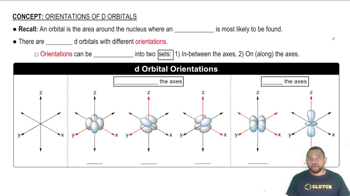
Step 4: Now, draw the dxy orbital of the metal atom 'M'. This orbital should also have lobes with phases, and it lies in the plane of the paper. The orientation of the dxy orbital should allow for overlap with the π*2p orbital of CO.
Step 5: Consider the type of bond formed between the metal and carbon. Since the overlap involves the π*2p orbital of CO and the dxy orbital of the metal, this interaction is a π bond. Predict that the CO bond strength in the metal–CO complex will decrease compared to CO alone due to the backbonding interaction.

주요 개념

질문에 올바르게 답하기 위해 반드시 이해해야 하는 핵심 개념들은 다음과 같습니다.

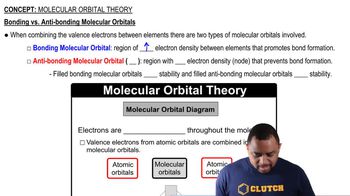
Molecular Orbitals

Molecular orbitals (MOs) are formed by the combination of atomic orbitals when atoms bond together. They can be classified as bonding, antibonding, or non-bonding. Bonding orbitals stabilize the molecule, while antibonding orbitals destabilize it. Understanding MOs is crucial for analyzing how atoms interact and form bonds, particularly in complex systems like metal-carbon monoxide interactions.
추천 영상:
가이드 코스
03:06
Molecular Orbital Theory

d-π Backbonding

d-π backbonding refers to the interaction between the d orbitals of a metal atom and the π* (antibonding) orbitals of a ligand, such as carbon monoxide. This process allows for the stabilization of the metal-ligand complex by facilitating electron donation from the metal to the ligand's antibonding orbital. It plays a significant role in the strength and characteristics of metal-ligand bonds, influencing the overall stability of coordination complexes.
추천 영상:
가이드 코스
02:06
d Orbital Orientations

Bond Types: σ and π Bonds

Bonds between atoms can be classified as σ (sigma) or π (pi) bonds based on their formation. A σ bond is formed by the head-on overlap of orbitals, providing a strong bond along the axis connecting the two nuclei. In contrast, a π bond results from the side-to-side overlap of p orbitals, which is generally weaker. Identifying the type of bond formed in metal-ligand interactions is essential for predicting the properties and reactivity of the resulting complex.
추천 영상: