
Ch.9 - Molecular Geometry and Bonding Theories
Brown - Chemistry: The Central Science 14th Edition
Brown14th EditionChemistry: The Central ScienceISBN: 9780134414232당신이 사용하는 게 아니라요?교과서 변경
9장, 문제 118

(b) Determine ΔH for the atomization of naphthalene using Hess’s law and the data in Appendix C. (ΔHf° of solid naphthalene is 77.1 kJ/mol and the molar heat of sublimation of naphthalene is 72.9 kJ/mol.)

검증된 단계별 안내
1
Identify the process of atomization for naphthalene, which involves converting solid naphthalene into gaseous atoms.
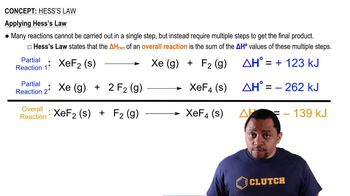
Use Hess's Law, which states that the total enthalpy change for a reaction is the same, no matter how many steps the reaction is carried out in.
Recognize that the enthalpy change for atomization can be found by adding the enthalpy of sublimation to the enthalpy of formation of gaseous naphthalene.
Calculate the enthalpy of formation of gaseous naphthalene by adding the enthalpy of formation of solid naphthalene to the molar heat of sublimation.
The enthalpy change for atomization is the sum of the enthalpy of formation of gaseous naphthalene and the energy required to break all bonds in the gaseous naphthalene to form individual atoms.

주요 개념

질문에 올바르게 답하기 위해 반드시 이해해야 하는 핵심 개념들은 다음과 같습니다.

Hess's Law

Hess's Law states that the total enthalpy change for a chemical reaction is the sum of the enthalpy changes for each step of the reaction, regardless of the pathway taken. This principle allows us to calculate the enthalpy change for a reaction by using known enthalpy changes of related reactions, making it essential for determining ΔH in complex processes like atomization.
추천 영상:

Standard Enthalpy of Formation (ΔHf°)

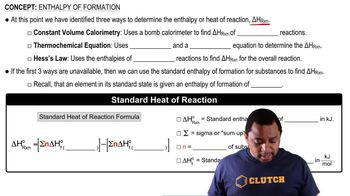
The standard enthalpy of formation (ΔHf°) is the change in enthalpy when one mole of a compound is formed from its elements in their standard states. For naphthalene, the given ΔHf° of 77.1 kJ/mol indicates the energy required to form solid naphthalene from its constituent elements, which is crucial for calculating the overall enthalpy change during atomization.
추천 영상:
가이드 코스
02:34
Enthalpy of Formation

Molar Heat of Sublimation

The molar heat of sublimation is the amount of energy required to convert one mole of a solid directly into a gas at constant pressure. For naphthalene, the molar heat of sublimation of 72.9 kJ/mol represents the energy needed to transition from solid to gas, which is a key component in determining the total enthalpy change for the atomization process.
추천 영상:
관련 실천
교과서 질문

The organic molecules shown here are derivatives of benzene in which six-membered rings are 'fused' at the edges of the hexagons.

(b) Suppose you are given a sample of one of the compounds. Could combustion analysis be used to determine unambiguously which of the three it is?

461
views
교과서 질문
Many compounds of the transition-metal elements contain direct bonds between metal atoms. We will assume that the z-axis is defined as the metal–metal bond axis. (d) Sketch the energylevel diagram for the Sc2 molecule, assuming that only the 3d orbital from part (a) is important.
353
views
교과서 질문
The organic molecules shown here are derivatives of benzene in which six-membered rings are 'fused' at the edges of the hexagons.

(e) Benzene, naphthalene, and anthracene are colorless, but tetracene is orange. What does this imply about the relative HOMO–LUMO energy gaps in these molecules? See the 'Chemistry Put to Work' box on orbitals and energy.
644
views
교과서 질문
The phosphorus trihalides 1PX32 show the following variation in the bond angle X¬P¬X: PF3, 96.3°; PCl3, 100.3°; PBr3, 101.0°; PI3, 102.0°. The trend is generally attributed to the change in the electronegativity of the halogen. (b) What is the general trend in the X¬P¬X angle as the halide electronegativity increases?
1454
views
교과서 질문

Sulfur tetrafluoride 1SF42 reacts slowly with O2 to form sulfur

tetrafluoride monoxide 1OSF42 according to the following

unbalanced reaction:

SF41g2 + O21g2¡OSF41g2

The O atom and the four F atoms in OSF4 are bonded to a

central S atom.

(e) For each of the molecules you drew in part (d), state how many

fluorines are equatorial and how many are axial.

102
views