Ch.9 - Molecular Geometry and Bonding Theories
Brown - Chemistry: The Central Science 14th Edition
Brown14th EditionChemistry: The Central ScienceISBN: 9780134414232당신이 사용하는 게 아니라요?교과서 변경
9장, 문제 71a

Consider the H2+ ion. (a) Sketch the molecular orbitals of the ion and draw its energy-level diagram.

검증된 단계별 안내
1
Identify the atomic orbitals of the hydrogen atoms that will combine to form molecular orbitals. In the case of H2+, each hydrogen atom contributes one 1s orbital.
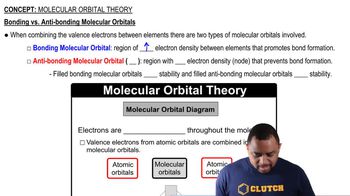
Understand the concept of molecular orbital theory, which states that atomic orbitals combine to form new orbitals called molecular orbitals. These can be bonding or antibonding orbitals.
Sketch the molecular orbitals for H2+. The combination of two 1s orbitals results in the formation of a bonding molecular orbital (σ1s) and an antibonding molecular orbital (σ*1s).
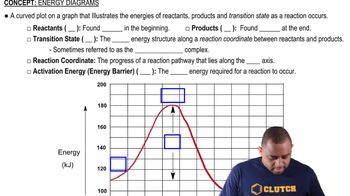
Draw the energy-level diagram for H2+. Place the σ1s orbital at a lower energy level than the original 1s atomic orbitals, indicating a more stable (lower energy) state. Place the σ*1s orbital at a higher energy level than the original 1s atomic orbitals, indicating a less stable (higher energy) state.
Fill the molecular orbitals with the available electrons. H2+ has a total of one electron, which will occupy the lower energy σ1s orbital, indicating a bond formation in the molecular ion.

비슷한 문제에 대한 검증된 영상 답변:

이 영상 해법은 위 문제에 도움이 된다고 튜터들이 추천한 것입니다.
영상 길이:
2m

주요 개념

질문에 올바르게 답하기 위해 반드시 이해해야 하는 핵심 개념들은 다음과 같습니다.

Molecular Orbitals

Molecular orbitals (MOs) are formed by the linear combination of atomic orbitals (LCAO) when atoms bond together. In the case of diatomic molecules like H2+, the MOs can be classified as bonding or antibonding. Bonding MOs lower the energy of the system and stabilize the molecule, while antibonding MOs increase energy and destabilize it. Understanding the arrangement and energy levels of these orbitals is crucial for predicting the stability and properties of the ion.
추천 영상:
가이드 코스
03:06
Molecular Orbital Theory

Energy-Level Diagram

An energy-level diagram visually represents the relative energies of molecular orbitals in a molecule or ion. In the case of H2+, the diagram will show the bonding molecular orbital (σ) at a lower energy level and the antibonding molecular orbital (σ*) at a higher energy level. The placement of electrons in these orbitals, according to the Aufbau principle and Hund's rule, helps determine the overall stability and magnetic properties of the ion.
추천 영상:
가이드 코스
01:57
Energy Diagrams

H2+ Ion Characteristics

The H2+ ion is a simple molecular ion consisting of two hydrogen nuclei and one electron. Its unique characteristics arise from the presence of only one electron, which allows for a straightforward analysis of its molecular orbitals. The ion's behavior can be understood through quantum mechanics, particularly in how the single electron occupies the bonding molecular orbital, leading to a net attractive force between the nuclei, thus influencing its stability and energy.
추천 영상:
가이드 코스
02:59
Acid Characteristics