Ch.9 - Molecular Geometry and Bonding Theories
Brown - Chemistry: The Central Science 14th Edition
Brown14th EditionChemistry: The Central ScienceISBN: 9780134414232당신이 사용하는 게 아니라요?교과서 변경
9장, 문제 88d

Consider the molecule PF4Cl. (d) Would you expect the molecule to distort from its ideal electron-domain geometry? If so, how would it distort?

검증된 단계별 안내
1
Identify the central atom in the molecule PF4Cl, which is phosphorus (P).
Determine the electron-domain geometry around the central atom based on the number of electron groups (bonds and lone pairs). Phosphorus in PF4Cl has five electron groups (four F atoms and one Cl atom bonded to it), suggesting a trigonal bipyramidal electron-domain geometry.
Consider the positions of the atoms in the trigonal bipyramidal geometry. The positions include two axial and three equatorial sites.
Analyze the differences in electronegativity between the fluorine (F) and chlorine (Cl) atoms. Fluorine is more electronegative than chlorine.
Predict the distortion: Since F is more electronegative than Cl, F atoms will occupy the equatorial positions to minimize repulsion, and the Cl atom will occupy one of the axial positions. This arrangement can lead to a slight distortion from the ideal trigonal bipyramidal geometry due to differences in bond angles caused by the different atoms.

비슷한 문제에 대한 검증된 영상 답변:

이 영상 해법은 위 문제에 도움이 된다고 튜터들이 추천한 것입니다.
영상 길이:
2m
도움이 되었나요?

주요 개념

질문에 올바르게 답하기 위해 반드시 이해해야 하는 핵심 개념들은 다음과 같습니다.

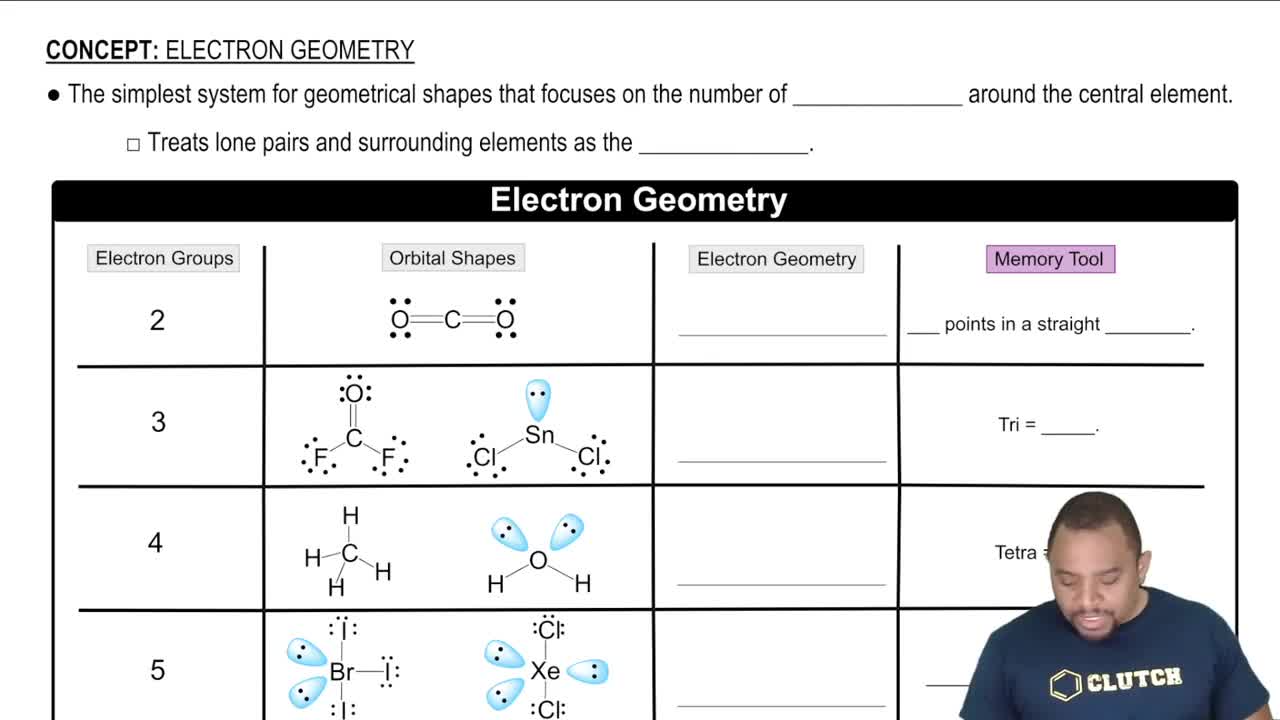
Electron-Domain Geometry

Electron-domain geometry refers to the spatial arrangement of electron pairs around a central atom, which can include bonding pairs and lone pairs. In the case of PF4Cl, the central phosphorus atom is surrounded by five electron domains (four fluorine atoms and one chlorine atom), leading to a trigonal bipyramidal geometry according to VSEPR theory.
추천 영상:
가이드 코스
04:44
Electron Geometry

Steric Effects

Steric effects arise from the repulsion between electron clouds of atoms or groups in a molecule. In PF4Cl, the presence of different atoms (F and Cl) can lead to variations in bond angles and distances due to their differing sizes and electronegativities, which can cause the molecule to distort from its ideal geometry.
추천 영상:
가이드 코스
02:31
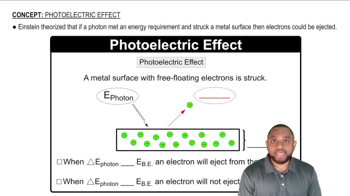
Photoelectric Effect

Lone Pair Repulsion

Lone pair repulsion is a significant factor in molecular geometry, as lone pairs occupy more space than bonding pairs. Although PF4Cl does not have lone pairs on the phosphorus atom, the differing electronegativities and sizes of the bonded atoms can still lead to distortions in the ideal geometry, affecting bond angles and overall shape.
추천 영상:
가이드 코스
00:47
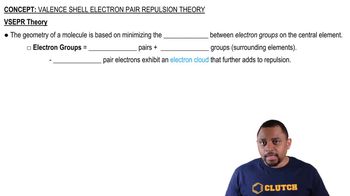
Valence Shell Electron Pair Repulsion Theory