Ch.9 - Molecular Geometry and Bonding Theories
Brown - Chemistry: The Central Science 14th Edition
Brown14th EditionChemistry: The Central ScienceISBN: 9780134414232당신이 사용하는 게 아니라요?교과서 변경
9장, 문제 72

(e) Which of the following statements about part (d) is correct: (i) The light excites an electron from a bonding orbital to an antibonding orbital, (ii) The light excites an electron from an antibonding orbital to a bonding orbital, or (iii) In the excited state there are more bonding electrons than antibonding electrons?

검증된 단계별 안내
1
Identify the nature of the electronic transition described in part (d) of the problem. Typically, light absorption involves the excitation of an electron from a lower energy orbital to a higher energy orbital.
Recall that bonding orbitals are lower in energy compared to antibonding orbitals. Therefore, an electron is usually excited from a bonding orbital to an antibonding orbital when light is absorbed.
Consider the implications of each statement: (i) suggests an electron is excited from a bonding to an antibonding orbital, which is a common scenario in electronic transitions.
Evaluate statement (ii), which suggests an electron is excited from an antibonding to a bonding orbital. This is less common as it would require energy release rather than absorption.
Analyze statement (iii), which implies that in the excited state, there are more bonding electrons than antibonding electrons. This would depend on the specific electronic configuration after excitation.

주요 개념

질문에 올바르게 답하기 위해 반드시 이해해야 하는 핵심 개념들은 다음과 같습니다.

Molecular Orbitals

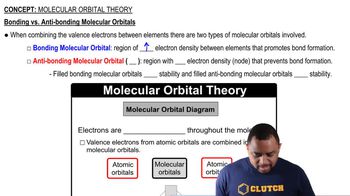
Molecular orbitals are formed from the combination of atomic orbitals when atoms bond together. They can be classified as bonding orbitals, which stabilize the molecule, and antibonding orbitals, which destabilize it. Understanding the distribution of electrons in these orbitals is crucial for predicting how molecules interact with light and undergo electronic transitions.
추천 영상:
가이드 코스
03:06
Molecular Orbital Theory

Electronic Transitions

Electronic transitions refer to the movement of electrons between different energy levels or orbitals within a molecule when it absorbs energy, such as light. When light is absorbed, an electron can be excited from a lower energy state (bonding orbital) to a higher energy state (antibonding orbital). This concept is fundamental in understanding how molecules absorb light and the resulting changes in their electronic structure.
추천 영상:
가이드 코스
00:53
Electron Configurations Of Transition Metals Example

Bonding vs. Antibonding Electrons

In molecular orbital theory, bonding electrons are those found in bonding orbitals, which contribute to the stability of the molecule, while antibonding electrons are located in antibonding orbitals and can weaken the bond. The ratio of bonding to antibonding electrons influences the overall stability and reactivity of the molecule. Analyzing these ratios is essential for understanding the implications of electronic transitions on molecular properties.
추천 영상:
가이드 코스
03:37
Bond Angles and Electron Groups