Give the approximate values for the indicated bond angles in the following molecules: (d)
Ch.9 - Molecular Geometry and Bonding Theories
9장, 문제 30a
Give the approximate values for the indicated bond angles in the following molecules: (a)
검증된 단계별 안내1
Identify the central atom in the molecule.
Determine the electron domain geometry around the central atom using the VSEPR theory, which considers both bonding and non-bonding electron pairs.
Count the number of bonding pairs and lone pairs around the central atom to predict the molecular geometry.
Use the molecular geometry to estimate the bond angles. For example, tetrahedral geometries have bond angles of about 109.5°, trigonal planar geometries have bond angles of about 120°, and linear geometries have bond angles of about 180°.
Consider any deviations from ideal bond angles due to factors such as lone pairs or double bonds, which can slightly alter the angles.

비슷한 문제에 대한 검증된 영상 답변:
이 영상 해법은 위 문제에 도움이 된다고 튜터들이 추천한 것입니다.
영상 길이:
2m도움이 되었나요?
주요 개념
질문에 올바르게 답하기 위해 반드시 이해해야 하는 핵심 개념들은 다음과 같습니다.
Bond Angles
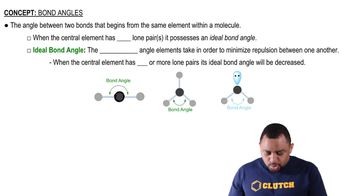
Bond angles are the angles formed between two adjacent bonds at a central atom in a molecule. They are crucial for understanding molecular geometry and are influenced by the arrangement of electron pairs around the central atom, which can be predicted using VSEPR (Valence Shell Electron Pair Repulsion) theory.
추천 영상:
가이드 코스
Bond Angles
VSEPR Theory
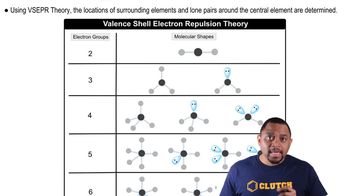
VSEPR theory is a model used to predict the geometry of individual molecules based on the repulsion between electron pairs surrounding a central atom. According to this theory, electron pairs will arrange themselves to minimize repulsion, leading to specific bond angles characteristic of different molecular shapes, such as linear, trigonal planar, or tetrahedral.
추천 영상:
가이드 코스
Molecular Shapes and VSEPR
Molecular Geometry
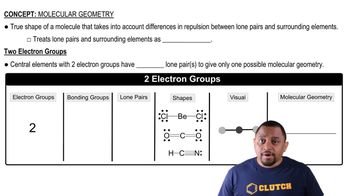
Molecular geometry refers to the three-dimensional arrangement of atoms within a molecule. It is determined by the number of bonding and non-bonding electron pairs around the central atom, which influences the bond angles. Common geometries include linear (180°), trigonal planar (120°), and tetrahedral (109.5°), each with distinct bond angles.
추천 영상:
가이드 코스
Molecular Geometry with Two Electron Groups
관련 실천
교과서 질문
1408
views
교과서 질문
Ammonia, NH3, reacts with incredibly strong bases to produce the amide ion, NH2-. Ammonia can also react with acids to produce the ammonium ion, NH4+. (a) Which species (amide ion, ammonia, or ammonium ion) has the largest H¬N¬H bond angle? (b) Which species has the smallest H¬N¬H bond angle?
1045
views
교과서 질문
Give the approximate values for the indicated bond angles in the following molecules: (c)
489
views
교과서 질문
The figure that follows contains ball-and-stick drawings of three possible shapes of an AF4 molecule. (c) Which of the following elements will lead to an AF4 molecule with the shape in (iii): Be, C, S, Se, Si, Xe? i.
ii.
iii.
852
views
교과서 질문
Give the approximate values for the indicated bond angles in the following molecules: (a)
492
views