Ch.9 - Molecular Geometry and Bonding Theories
Brown - Chemistry: The Central Science 14th Edition
Brown14th EditionChemistry: The Central ScienceISBN: 9780134414232당신이 사용하는 게 아니라요?교과서 변경
9장, 문제 21b

How many nonbonding electron pairs are there in each of the following molecules: (b) HCN

검증된 단계별 안내
1
Step 1: Draw the Lewis structure for the molecule. For HCN, the Lewis structure would be H-C≡N. This shows that hydrogen (H) is single-bonded to carbon (C), and carbon is triple-bonded to nitrogen (N).
Step 2: Determine the number of valence electrons for each atom. Hydrogen has 1, carbon has 4, and nitrogen has 5.
Step 3: Calculate the total number of bonding electrons. Each bond represents 2 electrons. In HCN, there are 4 bonds (1 single bond and 1 triple bond), so there are 8 bonding electrons.
Step 4: Subtract the total number of bonding electrons from the total number of valence electrons. This will give you the number of nonbonding electrons. In HCN, there are 10 valence electrons (1 from H, 4 from C, and 5 from N) and 8 bonding electrons, so there are 2 nonbonding electrons.
Step 5: Divide the number of nonbonding electrons by 2 to get the number of nonbonding electron pairs. In HCN, there are 2 nonbonding electrons, so there is 1 nonbonding electron pair.

비슷한 문제에 대한 검증된 영상 답변:

이 영상 해법은 위 문제에 도움이 된다고 튜터들이 추천한 것입니다.
영상 길이:
3m

주요 개념

질문에 올바르게 답하기 위해 반드시 이해해야 하는 핵심 개념들은 다음과 같습니다.

Lewis Structures

Lewis structures are diagrams that represent the bonding between atoms in a molecule and the lone pairs of electrons that may exist. They help visualize how many valence electrons are available for bonding and how they are distributed among the atoms. Understanding how to draw Lewis structures is essential for identifying nonbonding electron pairs.
추천 영상:
가이드 코스
04:28
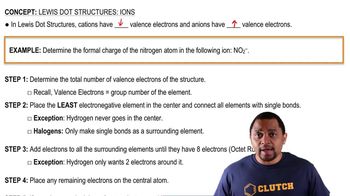
Lewis Dot Structures: Ions

Valence Electrons

Valence electrons are the outermost electrons of an atom and are crucial for chemical bonding. The number of valence electrons determines how an atom can bond with others, including the formation of bonds and the presence of lone pairs. In the case of HCN, knowing the valence electrons of hydrogen, carbon, and nitrogen is key to determining the number of nonbonding pairs.
추천 영상:
가이드 코스
02:12
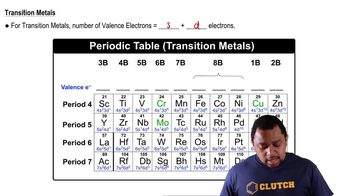
Transition Metals Valence Electrons

Nonbonding Electron Pairs

Nonbonding electron pairs, also known as lone pairs, are pairs of valence electrons that are not involved in bonding with other atoms. These pairs can influence the geometry and reactivity of a molecule. In HCN, identifying the nonbonding pairs is essential for understanding its molecular structure and properties.
추천 영상:
가이드 코스
00:47
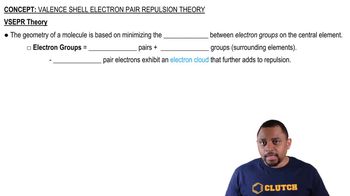
Valence Shell Electron Pair Repulsion Theory