
Ch.9 - Molecular Geometry and Bonding Theories
Brown - Chemistry: The Central Science 14th Edition
Brown14th EditionChemistry: The Central ScienceISBN: 9780134414232당신이 사용하는 게 아니라요?교과서 변경
9장, 문제 101

For one of the resonance forms of ozone, O3, which of the orbitals are used to make bonds and which are used to hold nonbonding pairs of electrons?

검증된 단계별 안내
1
Identify the molecular structure of ozone (O3), which consists of three oxygen atoms arranged in a bent shape.
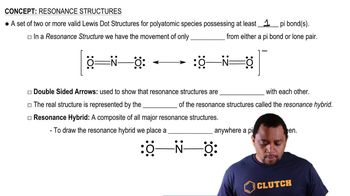
Recognize that ozone has resonance structures, meaning that the actual structure is a hybrid of multiple possible structures.
In one resonance form, consider the central oxygen atom forming a double bond with one of the terminal oxygen atoms and a single bond with the other terminal oxygen atom.
Determine that the sigma (σ) bonds are formed using sp2 hybrid orbitals on the central oxygen atom, while the pi (π) bond is formed using unhybridized p orbitals.
Identify that the nonbonding pairs of electrons (lone pairs) on the central oxygen atom are held in the remaining sp2 hybrid orbitals.

주요 개념

질문에 올바르게 답하기 위해 반드시 이해해야 하는 핵심 개념들은 다음과 같습니다.

Resonance Structures

Resonance structures are different ways of drawing the same molecule that illustrate the delocalization of electrons. In ozone (O3), resonance forms show how the double bond can shift between the oxygen atoms, affecting the distribution of electrons. Understanding resonance is crucial for predicting molecular behavior and stability.
추천 영상:
가이드 코스
01:42
Resonance Structures

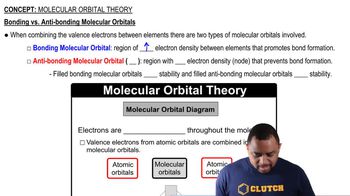
Molecular Orbitals

Molecular orbitals are formed by the combination of atomic orbitals when atoms bond together. In ozone, the bonding involves the overlap of p orbitals from the oxygen atoms, which create bonding and antibonding molecular orbitals. Recognizing which orbitals participate in bonding versus those that hold lone pairs is essential for understanding the molecule's structure.
추천 영상:
가이드 코스
03:06
Molecular Orbital Theory

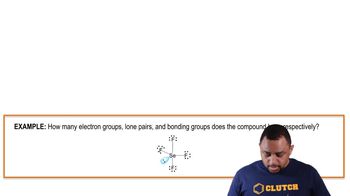
Lone Pairs and Bonding Pairs

Lone pairs are pairs of valence electrons that are not involved in bonding, while bonding pairs are shared between atoms to form covalent bonds. In ozone, certain p orbitals are occupied by lone pairs, influencing the molecule's geometry and reactivity. Identifying these pairs helps in visualizing the electron distribution and predicting molecular properties.
추천 영상:
가이드 코스
00:51
Electron Groups, Lone Pairs, and Bonding Groups Example