Ch.9 - Molecular Geometry and Bonding Theories
Brown - Chemistry: The Central Science 14th Edition
Brown14th EditionChemistry: The Central ScienceISBN: 9780134414232당신이 사용하는 게 아니라요?교과서 변경
9장, 문제 65d

In the formate ion, HCO2-, the carbon atom is the central atom with the other three atoms attached to it. (d) How many electrons are in the p system of the ion? 

검증된 단계별 안내
1
Step 1: Identify the atoms involved in the formate ion, HCO2-. The ion consists of one hydrogen (H), one carbon (C), and two oxygen (O) atoms.
Step 2: Determine the total number of valence electrons in the formate ion. Carbon has 4 valence electrons, each oxygen has 6 valence electrons, and hydrogen has 1 valence electron. Additionally, the negative charge indicates an extra electron.
Step 3: Draw the Lewis structure for the formate ion. Place carbon in the center, with the two oxygen atoms and one hydrogen atom bonded to it. Distribute the electrons to satisfy the octet rule for carbon and oxygen, and the duet rule for hydrogen.
Step 4: Identify the pi bonds in the structure. Pi bonds are formed from the side-to-side overlap of p orbitals. In the formate ion, look for double bonds between carbon and oxygen, which contain one sigma bond and one pi bond.
Step 5: Count the electrons in the pi system. Each pi bond contributes two electrons to the pi system. Sum the electrons from all pi bonds to find the total number of electrons in the p system of the ion.

비슷한 문제에 대한 검증된 영상 답변:

이 영상 해법은 위 문제에 도움이 된다고 튜터들이 추천한 것입니다.
영상 길이:
6m

주요 개념

질문에 올바르게 답하기 위해 반드시 이해해야 하는 핵심 개념들은 다음과 같습니다.

Valence Electrons

Valence electrons are the outermost electrons of an atom and are crucial for understanding chemical bonding and molecular structure. In the case of the formate ion (HCO2-), the carbon atom has four valence electrons, while the oxygen atoms contribute additional electrons, and the hydrogen atom contributes one. The total number of valence electrons determines how the atoms bond and the overall charge of the ion.
추천 영상:
가이드 코스
02:12
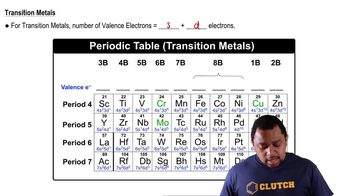
Transition Metals Valence Electrons

Molecular Geometry

Molecular geometry refers to the three-dimensional arrangement of atoms within a molecule. In the formate ion, the carbon atom is central, and the arrangement of the hydrogen and oxygen atoms around it affects the ion's shape and properties. Understanding molecular geometry is essential for predicting the behavior of the ion in chemical reactions and interactions.
추천 영상:
가이드 코스
01:33
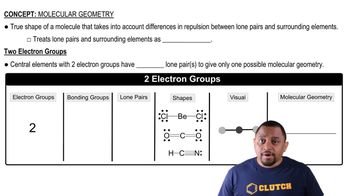
Molecular Geometry with Two Electron Groups

p System Electrons

The p system refers to the electrons in the p orbitals of an atom, which can participate in bonding and resonance structures. In the formate ion, the p orbitals of the oxygen atoms are involved in forming double bonds with carbon, contributing to the resonance stabilization of the ion. Counting the p system electrons is important for understanding the ion's electronic structure and reactivity.
추천 영상:
가이드 코스
02:06
Entropy of the System